
Wilderness Fishing Gear: The Backcountry Pack Checklist

Updated: Sep 12
TL;DR:
A minimal, modular fishing kit with a quality reel, travel rod, six-pound line, and small tackle pouch is enough for backcountry freshwater fishing. Organizing pre-tied leaders, choosing lightweight, multi-use gear, and packing a repair kit enable effective fishing without excess weight or clutter. Always verify local regulations before heading outdoors to ensure legal and responsible angling.
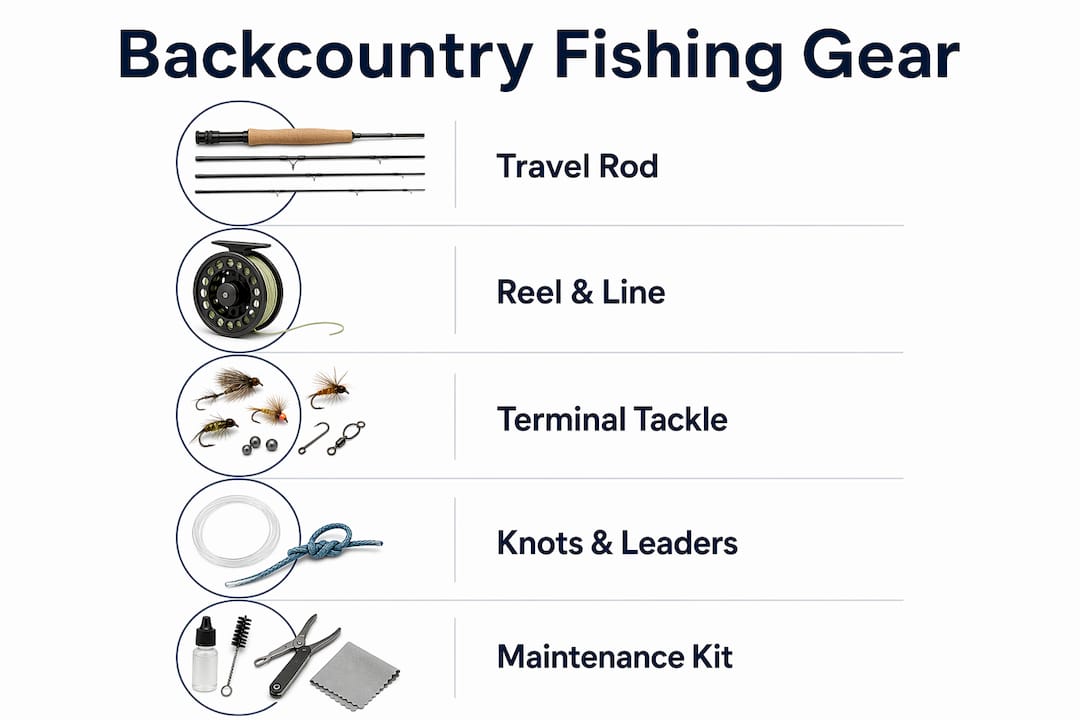
For any backcountry trip where fishing is part of the plan, the minimal kit that actually earns its weight is this: a telescopic or two-piece travel rod, a quality spinning reel, a moderate-strength monofilament or fluorocarbon line suitable for most freshwater species, a small selection of terminal tackle, a knife or multitool, and a waterproof modular pack to hold it all. That’s your baseline. Everything else is optional weight.
Core kit at a glance:
Telescopic or travel rod (5–7 ft, ultralight to medium-light power)
Spinning reel (size 1000–2500, sealed drag preferred)
6 lb monofilament or fluorocarbon line, suitable for most freshwater species
Terminal tackle pouch: hooks (sizes 6–12), split-shot sinkers, small swivels, 2–3 lures
Knife or multitool (doubles as line cutter, hook remover, camp tool)
Waterproof dry bag or modular backpack with tackle compartment
Lightweight folding net (optional but useful for solo catch-and-release)
Compact first-aid and repair kit
Pro Tip: Pre-rig three leader assemblies at home and store them in a small zip pouch. In the field, swapping a pre-tied leader takes 20 seconds instead of five minutes with cold hands.
Table of Contents
How do you choose rod, reel, and line for backcountry trips?
What terminal tackle and knots should you carry in the backcountry?
How to pack light and stay organized on a backcountry fishing trip
Field maintenance and quick repairs when you’re miles from help
How do you choose the right fishing gear for your specific trip?
Authoritative sources and where to check U.S. regulations before you go
What fishing gear do you actually need in the wilderness?
The goal is a kit that fits inside or alongside a survival pack without dominating it. Each item below pulls double duty where possible.
Travel or telescopic rod: Collapses to 18–24 inches for pack storage. Look for ceramic-lined guides, which reduce line wear compared to bare metal. Rod lengths of roughly 5–8 ft (about 1.5–2.4 m) cover most freshwater scenarios.
Spinning reel: A smooth, reliable reel mechanism matters more than rod brand. A sealed or semi-sealed drag resists grit and moisture in remote conditions.
Line: Spool 80–100 yards of 6 lb monofilament or fluorocarbon. That’s enough for most freshwater fishing without excess weight.
Terminal tackle pouch: Hooks, sinkers, swivels, and two or three lures fit in a 4×6-inch waterproof pouch.
Knife or multitool: Pliers that double as line cutters eliminate a separate tool. Needle-nose pliers are especially useful for hook removal and split-ring work.
Waterproof modular pack: Organized backpack systems outperform hard tackle boxes on rough terrain. Look for integrated dry compartments.
Compact net: A folding rubber-mesh net protects fish during catch-and-release and keeps hands free of slime.
First-aid and repair kit: See the field maintenance section for the exact contents.
Item | Backcountry Priority | Minimum Spec |
Travel rod | High | 5–7 ft, ultralight/medium-light, ceramic guides |
Spinning reel | High | Size 1000–2500, sealed drag |
Line | High | 6 lb monofilament or fluorocarbon, 80–100 yd spool |
Terminal tackle | High | Hooks 6–12, split-shot, 2–3 lures |
Knife/multitool | High | Needle-nose pliers + blade |
Waterproof pack | High | Modular, dry compartment |
Folding net | Medium | Rubber mesh, folds flat |
Repair kit | Medium | See field maintenance section |
How do you choose rod, reel, and line for backcountry trips?
Start with the reel. Spend as much of your budget there as you can. A smooth, well-sealed reel reduces line twists and mechanical failures in wet, remote conditions where you can’t run to a tackle shop. The rod matters, but a mid-grade rod with a quality reel outperforms the reverse combination on almost every trip.
For rods, resist the urge to buy one “do-it-all” stick. Match rod power and length to your tactic: a short ultralight (5–6 ft) for tight streams, a medium-light 6–7 ft for open lakes. Telescopic rods collapse for packing; two-piece rods are slightly more sensitive but require a rod tube or sleeve.
Line choice comes down to water clarity and species. Monofilament offers versatility and ease of use, fluorocarbon disappears in clear water, and braid gives sensitivity and strength in heavy cover. A 6 lb monofilament or fluorocarbon line covers most freshwater situations and is easy to manage on a spinning reel.
Rod Type | Pros | Cons | Best For |
Telescopic | Packs to 18–24 in, no tube needed | Slightly less sensitive | Backpacking, portage |
Two-piece travel | Better sensitivity, durable ferrule | Needs sleeve or tube | Day hikes, canoe trips |
Short ultralight (5–6 ft) | Precise in tight cover | Limited casting distance | Brushy streams |
Medium-light (6–7 ft) | Versatile, good cast distance | Bulkier to pack | Lakes, open rivers |
Pro Tip: Spool your reel at home, not streamside. Cold, wet hands and a full spool of loose line are a recipe for a bird’s nest that wastes 20 minutes of fishing time.
What terminal tackle and knots should you carry in the backcountry?
Learning to rig correctly produces better results than upgrading gear. Correct hook size, sinker selection, and knot competence consistently outperform expensive rods for most anglers in real-world conditions. Pack light, but pack smart.
Terminal tackle list:
Hooks sized appropriately to cover most freshwater species and panfish
Split-shot sinkers: assorted sizes, removable style
Small barrel swivels (size 10–12) to prevent line twist
12–18 inches of 6–8 lb fluorocarbon leader material
2–3 small lures: one inline spinner, one small soft plastic, one small spoon
Natural bait options: worms or PowerBait dough work in most freshwater environments
Simple rigs to know:
Bobber rig: Float + hook + split-shot. Best for still water, panfish, and trout near the surface.
Drop-shot rig: Sinker at the bottom, hook tied 8–12 inches above. Keeps bait off the bottom in clear water.
Simple leader trace: Swivel + 12-inch fluoro leader + lure. Reduces line twist and adds stealth for lure fishing.
Carolina rig: Sliding sinker, bead, swivel, 18-inch leader, hook. Good for covering bottom structure in lakes.
Four knots worth mastering:
Improved clinch: The standard hook-to-line knot. Fast, reliable, works on mono and fluoro.
Palomar: Stronger than the improved clinch on braid; also excellent for hooks and swivels.
Uni knot: Ties line to line or line to leader. One knot that handles multiple jobs.
Loop knot: Gives lures free movement on the retrieve, which increases action.
Pro Tip: Pre-tie three leader assemblies (swivel + 12-inch fluoro + hook) at home and coil them in a small zip pouch. Swapping a leader in the field takes seconds instead of minutes. For deeper fly-fishing knot and rigging technique, trout fly-fishing tips from First Rise Outfitters cover the basics well.
How to pack light and stay organized on a backcountry fishing trip
The single biggest packing mistake is bringing a full hard tackle box. It’s heavy, awkward on uneven ground, and offers no weather protection for electronics or personal items. A waterproof modular backpack with dedicated tackle compartments solves all three problems. Pair it with small waterproof zip pouches for terminal tackle, and you have a system that weighs a fraction of a traditional setup.
Weight-saving priorities:
Limit lures to three or four proven patterns, not a full tray.
Spool only 80–100 yards of line; you rarely need more in freshwater.
Choose a multitool with pliers over separate tools.
Use a soft tackle organizer roll instead of a hard box for terminal tackle.
Leave the landing net at camp if you’re doing catch-and-release in a stream with good footing.
Integrate fishing gear into your survival pack deliberately. The knife and multitool live on your belt or hip pocket, not buried in the pack. The repair kit and first-aid items share a single dry pouch near the top of the bag for fast access. For broader multi-use camp gear strategies, Thrillofit’s guide covers the overlap between fishing tools and general camp kit well.
Field maintenance and quick repairs when you’re miles from help
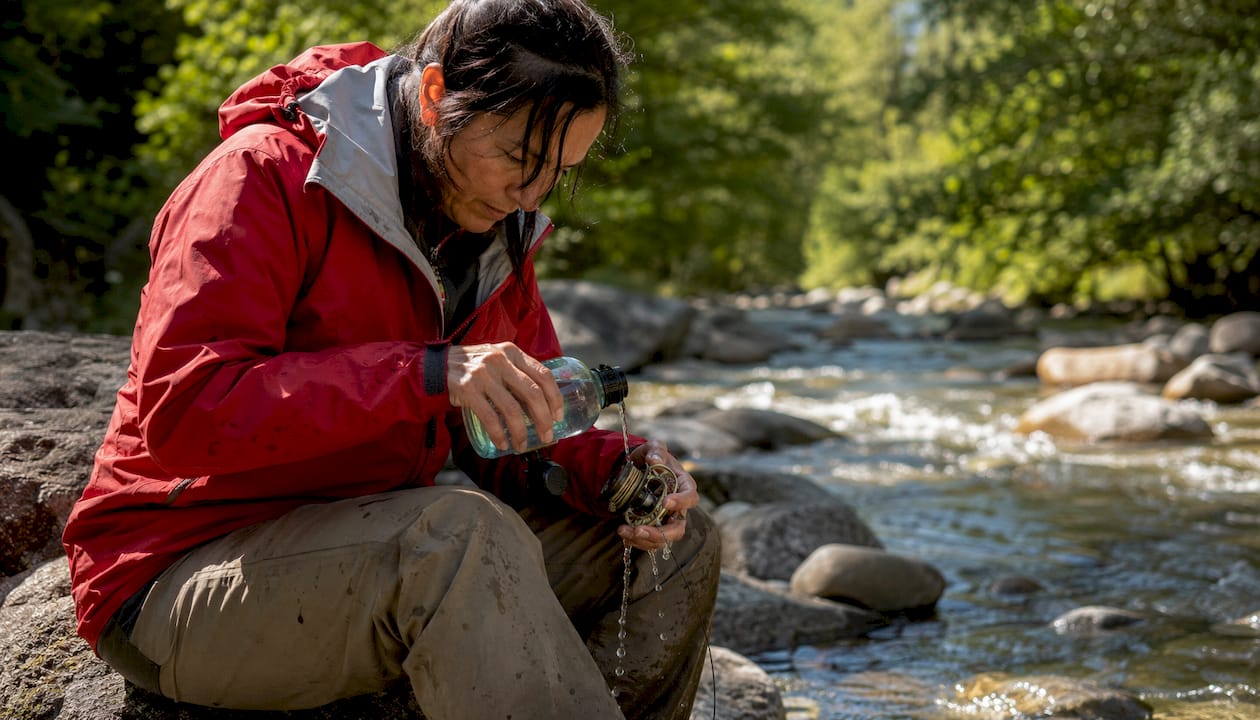
A mechanical failure doesn’t have to end your trip if you carry a small repair kit and know two or three fixes.
Minimal repair kit (fits in a 3×5-inch pouch):
10–15 yards of spare 6 lb mono or fluoro on a small spool
Super glue (single-use tube)
Electrical tape or duct tape (small wrap)
Two spare split rings
Spare leader material (12 inches of heavier fluoro)
Needle-nose pliers (already in your multitool)
Field repair steps:
Broken guide: Tie a bypass leader directly from the reel to the next intact guide using a loop knot. You lose some casting distance but can keep fishing.
Stuck drag: Rinse the reel with clean water if grit is the cause. Dry it, then apply a tiny drop of reel oil or lip balm to the drag washer as a temporary fix.
Snapped rod tip: Wrap the break with electrical tape as a splint. It won’t cast perfectly, but it holds for a session.
Line twist: Strip 20–30 yards of line off the reel and let it trail in moving water for 30 seconds. The current removes most twists.
After any wet exposure, rinse the reel with fresh water, dry the rod guides, and leave the bail arm open overnight to let moisture escape. Duct tape handles rod wraps, pack strap repairs, and a dozen other field fixes, so a small wrap belongs in every backcountry kit.
How do you choose the right fishing gear for your specific trip?
Use this decision checklist before you pack. It takes five minutes and prevents bringing the wrong kit.
What’s your pack weight limit? If you’re carrying more than 35 lbs total, cut the fishing kit to rod, reel, line, and a single terminal tackle pouch.
What species are you targeting? Trout and panfish: ultralight rod, 6 lb line. Bass or pike: medium-light rod, 8–12 lb line.
What’s the water type? Clear streams: fluorocarbon leader. Stained water or heavy cover: braid main line. Still, open water: mono works for everything.
How long is your trip? Overnight: pre-rig three leaders and pack only proven lures. Multi-day: add a spare spool of line and a few extra hooks.
What’s the weather forecast? Wind above 15 mph makes ultralight setups frustrating. Step up to a medium-light rod and heavier line in those conditions.
What’s your recovery time if gear fails? If you’re more than a day from a trailhead, carry the full repair kit. Day trips can skip it.
Red flags: what not to pack
Hard tackle boxes (heavy, awkward, no weather protection)
Conventional baitcasting reels (steep learning curve, poor in cold/wet conditions)
More than four lure types (duplicates add weight with no catch benefit)
Full-size rods over 7 ft (impractical in brush, difficult to pack)
Gear specs by common backcountry scenario
Scenario | Rod/Reel/Line | Terminal Tackle | Leave Behind |
Stream trout (tight brush) | 5–6 ft ultralight, size 1000 reel, 6 lb fluoro | Size 10–12 hooks, small spinners, split-shot | Heavy sinkers, large lures |
Alpine lake | 6–7 ft medium-light, size 1000–2500 reel, 6 lb mono | Size 8–10 hooks, small spoons, PowerBait | Braid (overkill), bobbers |
Marsh/brush edge | 6 ft medium-light, size 1000–2500 reel, 8 lb braid + fluoro leader | Size 6–8 hooks, soft plastics, swivels | Ultralight gear, bare hooks |
Kayak portage | 6–7 ft two-piece, size 1000–2500 reel, 6 lb mono | Inline spinners, size 8 hooks, split-shot | Hard tackle box, full net |
For marsh and edge scenarios, wind and vegetation cover change gear choice significantly. High wind pushes fish to sheltered banks; use heavier line and shorter casts rather than fighting the wind with ultralight gear. For a deeper look at marsh fishing setups, First Rise Outfitters breaks down the specific tackle considerations well.
Alpine lake fishing often means long, calm mornings with crystal-clear water. Fluorocarbon leader material is worth the extra cost there; fish in clear, still water are noticeably line-shy. Stream fishing in brushy terrain rewards a short rod and accurate short casts over distance every time.
Key Takeaways
A compact, modular fishing kit built around a quality reel, a travel rod, 6 lb line, and a small terminal tackle pouch covers the majority of backcountry freshwater scenarios without sacrificing pack space or survival priorities.
Point | Details |
Prioritize the reel | Spend the most of your budget on the reel; a smooth drag prevents failures in remote conditions. |
6 lb line as your baseline | A 6 lb monofilament or fluorocarbon line covers most freshwater species and is easy to manage on a spinning reel. |
Terminal tackle skill matters most | Correct hook size, knot competence, and rig selection produce more fish than expensive rods. |
Pack modular and waterproof | A waterproof backpack with small zip pouches outperforms hard tackle boxes on rough terrain. |
Pre-rig before you go | Three pre-tied leader assemblies save critical time and frustration in cold, wet field conditions. |
Why this kit holds up where it counts
There’s a version of fishing gear advice that reads like a tournament prep list: premium rods, specialized lures, a tackle box the size of a carry-on. None of that survives first contact with a three-day backcountry trip. What actually works is a kit built around repairability, weight discipline, and multi-use tools.
The wilderness-focused approach Thrillofit takes here isn’t about fishing less seriously. It’s about recognizing that when you’re two days from the trailhead, a stuck drag or a snapped guide tip is a real problem, and the solution is already in your pack. A sealed reel, a small repair pouch, pre-rigged leaders, and a multitool with pliers cover 90% of field failures. The fish don’t care whether your rod cost $80 or $400. They care whether your knot holds and your hook is the right size.
The survival-first mindset also changes how you think about fishing on a backcountry trip. It’s not just recreation; it’s a potential food source and a morale anchor on long expeditions. That reframes every gear decision: does this item earn its weight in multiple scenarios, or does it only do one thing? If it only does one thing, leave it at home. For more on building a complete wilderness kit around that same principle, Thrillofit’s survival gear resources are worth browsing before your next trip.
Authoritative sources and where to check U.S. regulations before you go
Before any fishing trip on public land or water in the United States, check your state’s fish and wildlife agency for current license requirements, season dates, and special regulations. Rules change annually, and fishing without a valid license carries real fines.
Take Me Fishing (Recreational Boating & Fishing Foundation): Covers rod, reel, and tackle selection for beginners through intermediate anglers, plus a license-finder tool by state.
Pennsylvania Fish and Boat Commission (pa.gov/agencies/fishandboat): Detailed beginner gear guidance including hook sizing, line selection, and knot basics. Applicable as a model for any U.S. freshwater angler.
U.S. Fish and Wildlife Service (fws.gov): Federal regulations for national wildlife refuges and migratory species; check here if your trip crosses into refuge land.
NOAA Fisheries (fisheries.noaa.gov): Relevant for coastal and anadromous species (salmon, steelhead) that may be encountered on wilderness trips near the coast.
Leave No Trace Center for Outdoor Ethics (lnt.org): Principles for minimizing fishing and camping impact, including proper fish handling, waste disposal, and campsite selection near water.
Always verify your state license is valid for the specific water body you plan to fish. Some waters require a separate stamp (trout, salmon) or fall under tribal or special-use agreements. When in doubt, call the state agency directly. This article is general information; confirm current rules with your state fish and wildlife agency before your trip.
Recommended
Comments