

8 Agency Backed Mountain Lion Safety Steps U.S. Hikers Can Rehearse

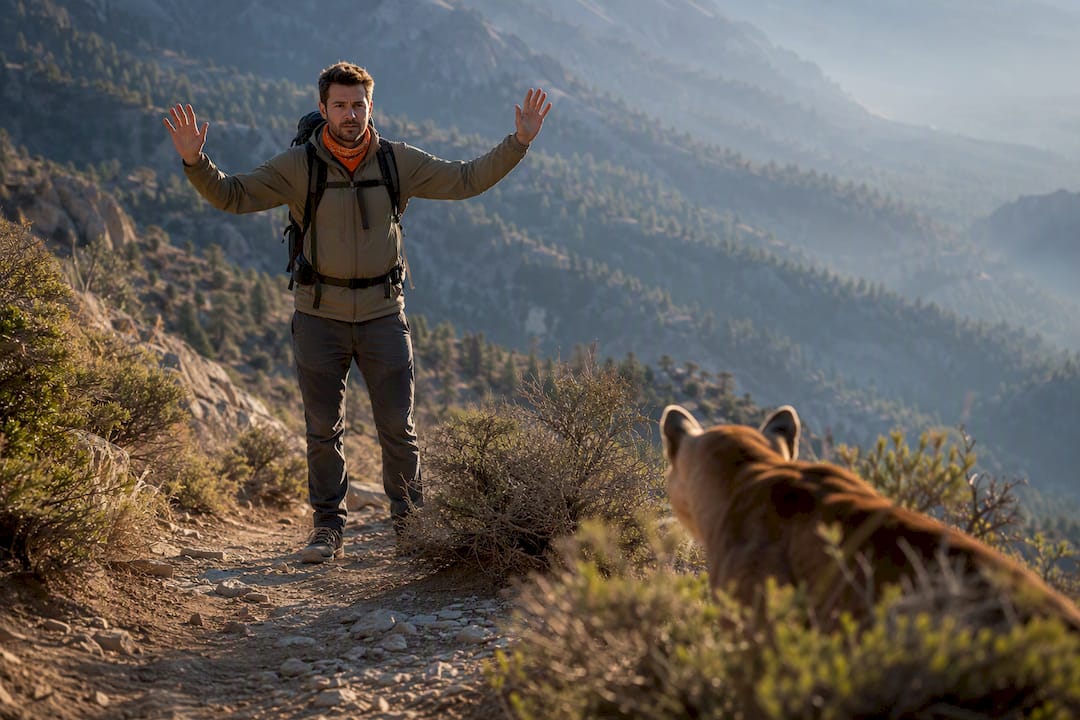
Do not run. Stand your ground, make yourself look as large as possible, keep eye contact, and fight back if you’re attacked. Mountain lion attacks are rare, but the National Park Service and U.S. Fish & Wildlife Service agree on this core response, and it works because it counters exactly how these cats hunt. Add prevention basics like avoiding solo dawn and dusk outings and keeping kids and pets close, and you cut your risk dramatically before you ever need the fight response.
TL;DR:
Most mountain lion encounters can be prevented by staying in groups, avoiding dawn and dusk outings, and making noise to alert animals of your presence.
If approached, standing tall, facing the lion, raising your arms, and using objects like jackets or sticks can deter an attack, with fighting back as a last resort.
Rehearsing safety responses, such as child pickup and using deterrent objects, improves reaction time and reduces panic during an actual encounter.
Securing yards by removing deer attractants, trimming vegetation, and installing motion lights significantly lowers the likelihood of lions approaching your home.
Reporting sightings and attacks promptly to wildlife authorities, and cleaning up carcasses quickly, helps authorities monitor and manage lion activity effectively.
Table of Contents
What to Do During a Close Mountain Lion Encounter
Your first move happens before the lion even reacts to you. The moment you spot a mountain lion at close range, plant your feet. Do not turn and sprint. Running triggers a predator’s chase instinct, and no human outruns a cat that can hit 50 miles per hour in short bursts.
Here’s the sequence to follow, in order:
Stop and face the lion directly. Keep your eyes on it. Looking away or turning your back signals prey behavior.
Make yourself big. Raise your arms, open your jacket, lift a backpack over your head. Height and bulk read as threat, not opportunity.
Back away slowly, only if the lion isn’t advancing. Never crouch, kneel, or bend down to grab a rock while your torso drops out of the lion’s line of sight. A crouched shape looks like prey.
Pick up children without turning away. Bend at the knees, keep your chest and face pointed at the animal, and lift straight up. Don’t scoop a child by twisting your body away from the lion, even for a second.
Raise your voice. Yell in a low, firm tone. Don’t scream in a high pitch that could mimic an injured animal.
Use whatever you’re holding. A trekking pole held out, a water bottle thrown, a jacket snapped open. All read as size and threat.
If the lion shows aggression, throw something at the ground in front of it first. This demonstrates you’re dangerous without landing a direct hit that could provoke an immediate charge, a technique Pinnacles National Park rangers specifically recommend for escalating encounters.
If it attacks, fight back. The NPS is direct on this point: people have successfully fought off mountain lions using rocks, sticks, fists, and hiking gear. Aim for the eyes and nose. Stay on your feet if at all possible.
The reason posture matters so much comes down to how these animals decide whether you’re a threat or a meal. A mountain lion sizing you up is reading silhouette, movement, and confidence. A tall, loud, forward-facing human doesn’t fit the profile of anything worth attacking. A small, quiet, retreating shape does.
Improvised defenses work better than people expect. A daypack held overhead adds a foot of apparent height. A trekking pole jabbed forward extends your reach and gives the lion a reason to reconsider. Even a rolled-up jacket snapped open like a cape has stopped a charge. What doesn’t work: playing dead. That’s advice for grizzly bear encounters, not mountain lions, and using it here can get you killed.
Pro Tip: Practice the “big and loud” response at home before you ever need it on a trail. Muscle memory beats panic. Stand up, throw your arms out, and say the words you’d yell, out loud, once a season. It sounds silly. It works.
Preventing Encounters While Hiking, Running, and Recreating
Most mountain lion encounters are preventable with a few changes to when and how you move through their habitat. The U.S. Forest Service notes that lions are most active at dawn, dusk, and night, and encounters cluster near areas with heavy deer activity, since deer are their primary prey.
Before you head out, a little trip planning goes a long way toward stacking the odds in your favor:
Choose busier, well-traveled trails over remote singletrack when you’re hiking solo.
Avoid dawn and dusk outings alone. If you must go out during those hours, bring a partner.
Travel in a group whenever possible. Lions rarely approach clusters of people.
Keep children within arm’s reach on trails known for lion activity, not ranging ahead or lagging behind.
Skip the headphones. Colorado Parks and Wildlife specifically flags situational awareness as one of the simplest, most overlooked prevention tools.
Make noise deliberately. Talking, clapping periodically, or wearing a bell reduces the odds of surprising a resting or feeding lion at close range.
Keep dogs leashed. An off-leash dog can trigger a chase response or provoke a defensive lion, and either way, you’re now dealing with the fallout.
Learning to read the landscape matters as much as the behavior rules. Scrapes, look like small piles of leaves, dirt, and pine needles scraped into a mound, mark territory and often sit near trails. A partially buried deer carcass, sometimes covered with dirt, leaves, or snow, is a cached kill a lion may return to guard. If you find one, leave the area immediately by the way you came. Don’t investigate. Don’t let a dog sniff around it. Fresh tracks (roughly two to three inches, with no visible claw marks, distinguishing them from dog and coyote prints) heading toward dense brush suggest an animal that’s nearby and active.
Runners and mountain bikers face a specific wrinkle: speed and quiet movement can mimic exactly the kind of quick, silent motion that triggers a predatory response. If you run or ride in lion country, consider varying your route and pace, run with a partner during low-light hours, and carry a whistle or air horn as a backup to your voice. A lion that hears you coming from a distance almost never wants an encounter any more than you do.

Securing Your Home, Property, Pets, and Livestock
Most residential mountain lion problems trace back to one root cause: deer. Where deer feed, lions follow, and yards that attract deer with plantings, salt blocks, or supplemental feeding are quietly inviting both animals into the neighborhood. Colorado Parks and Wildlife calls deer-proofing one of the most effective long-term safety measures a homeowner in lion country can take, ahead of fencing, ahead of lighting, ahead of almost anything else on this list.
Start with the landscape itself:
Stop feeding deer, and remove or fence off ornamental plants deer favor, like roses, hostas, and fruit trees.
Clear dense brush and overgrown vegetation within 30 feet of the house, patios, and children’s play areas. Lions use cover to stalk, and thick shrubs next to a walkway remove your ability to see one coming.
Trim tree limbs that overhang fences or rooflines, especially anything a lion could use to drop down from above.
Stack woodpiles away from the house and off the ground where possible; loose piles make convenient den sites for smaller prey that, in turn, draw lions.
Lighting and quick carcass removal round out the property basics. Motion-activated lights near entry points startle lions out of the habit of cutting through a yard at night. If you find roadkill or a dead animal on your property, don’t leave it to decompose. A carcass left in place becomes a feeding station that pulls a lion back to the same spot on a schedule.
Livestock owners carry the highest stakes here. Bring goats, sheep, and other small livestock into secure, roofed enclosures at night rather than open pens or pasture. Guardian animals, particularly livestock guardian dogs, add a real deterrent that most predators avoid testing. Fencing needs to be tall (at least eight feet for persistent problem areas) and free of low gaps a lion could slip under.
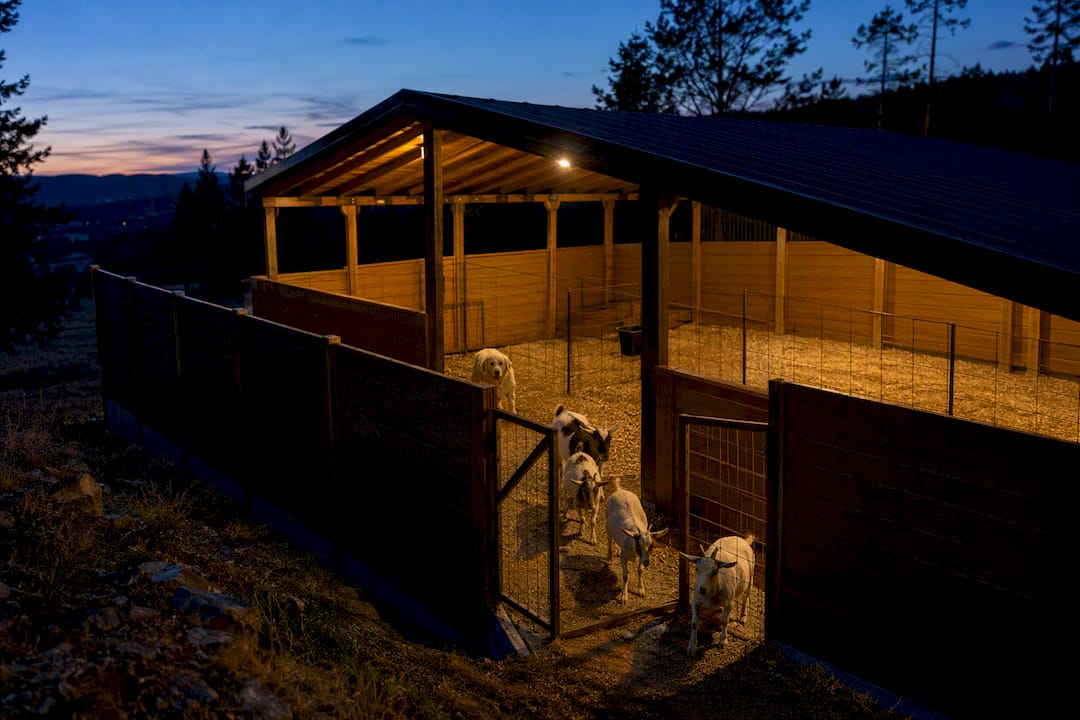
Pro Tip: If you’re seeing repeated lion activity near livestock despite these steps, contact your state wildlife agency’s damage-control or wildlife technician program before you consider handling it yourself. They can assess the specific animal and property and recommend targeted fixes.
Why Mountain Lions Behave the Way They Do
Mountain lions are ambush predators, not chase predators. They rely on stalking within a short striking distance, then a fast, powerful lunge, which is why sudden movement, a small silhouette or a retreating shape can trigger a predatory response even when the lion had no intention of engaging a moment earlier. Understanding this is exactly why the standard safety response, standing tall, facing the animal, refusing to flee, works: it removes every visual cue the lion associates with catchable prey.
The numbers back up how rare a dangerous encounter actually is. California’s Department of Fish and Wildlife has documented fewer than 50 verified mountain lion attacks on humans statewide since 1890, including a small number of fatalities, across more than 130 years of record-keeping in a state with one of the largest lion populations in the country. For context that people find genuinely surprising: across a comparable long stretch of time, far more Americans have died from lightning strikes than from mountain lion attacks nationwide.
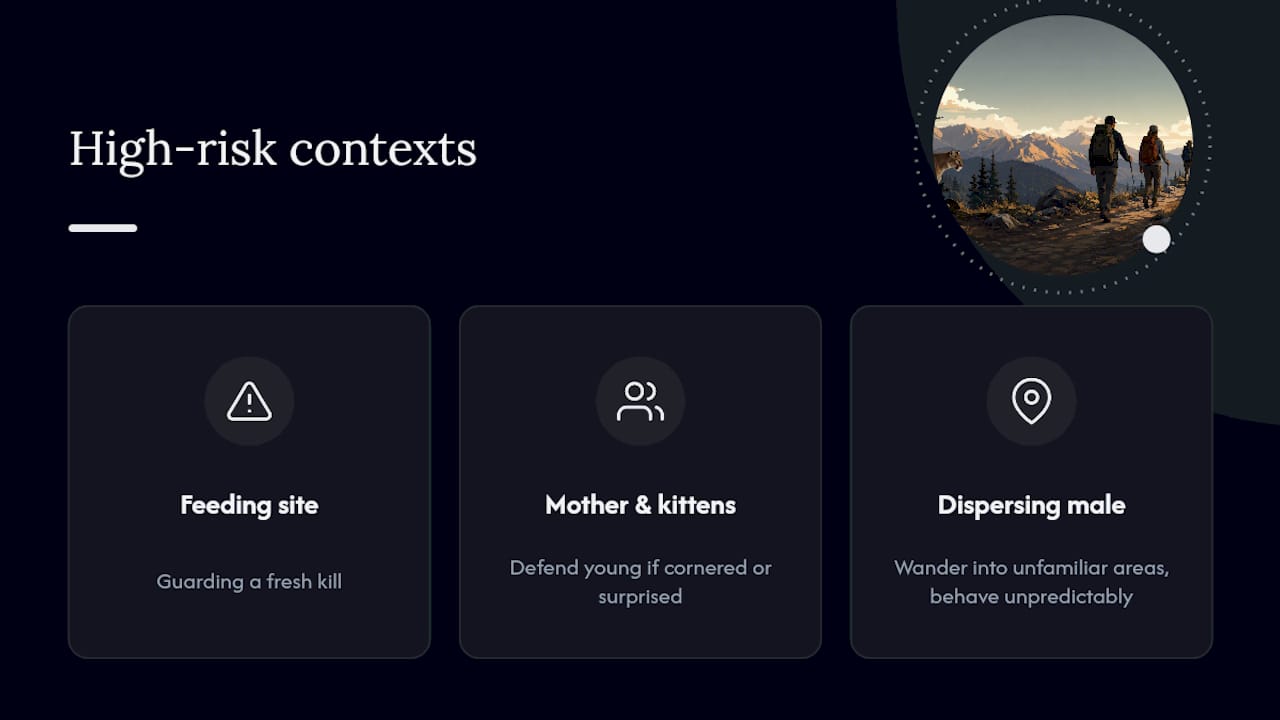
Certain situations do carry elevated risk. Encounters cluster around active feeding sites, where a lion is guarding a fresh kill and reluctant to abandon it. Mothers with kittens defend their young aggressively if they feel cornered or surprised. Young dispersing males, pushed out of established territory and searching for new ground, sometimes wander into unfamiliar areas, including suburban edges, and behave less predictably than settled adults.
None of this makes lions a threat to write off casually, but it does mean the fear many hikers carry is wildly out of proportion to the actual risk. Mountain lions also do the ecosystem real work, keeping deer populations in check and, by extension, protecting forest understory and reducing vehicle collisions with deer. Coexistence isn’t a compromise. It’s the more accurate read of the actual math.
After an Encounter: Reporting and Getting Care
What you do in the hours after an encounter depends entirely on what kind of encounter it was, and getting the right agency on the phone quickly matters both for your safety and for tracking the animal’s behavior pattern.
For a sighting inside a national park or forest, call the visitor center or the nearest ranger station. They log sightings and may issue trail alerts.
For a sighting in a populated or suburban area, contact your state wildlife agency’s dispatch or non-emergency line. They track patterns that inform local advisories.
For an attack or any injury, call 911 immediately. Emergency responders and wildlife officers typically coordinate on these calls.
When you report, gather what you can safely note: exact location (trailhead, mile marker, or GPS coordinates), time of day, what the lion was doing, and a physical description. Photos or video are useful only if capturing them doesn’t put you at further risk.
Medical care after a scratch or bite needs to happen fast, even for wounds that look minor. Clean the area, apply direct pressure to stop bleeding, and get to an emergency room. Mountain lion claws and teeth carry bacteria that cause serious infections, and public health officials may want documentation of the incident for wildlife-monitoring purposes.
Beyond your own report, tell your neighbors and, if it happened on a trail system, the land manager. Repeated sightings in one area sometimes prompt agencies to post signage or increase patrols, but that only happens when enough people actually report what they saw.
Field-Tested Mechanics Worth Practicing Before You Need Them
Reading the rules is one thing. Your body doing them under adrenaline is another. A few mechanics are worth rehearsing specifically.
When picking up a child, bend at the knees and keep your torso and head facing the lion the entire time, a technique the NPS specifically recommends to avoid presenting a crouched, prey-shaped silhouette.
Practice snapping a jacket open like a cape, and know where your trekking pole or water bottle is without looking for it.
If you carry a whistle or bear spray, know exactly which pocket it lives in, every time, on every hike.
Run a short rehearsal drill with your family or hiking group once a season: two to three minutes, call out roles, practice the child pickup, and simulate using a jacket or pole as a deterrent. Training calm, deliberate responses like this reduces the panic mistakes, like running, screaming in a high pitch, or turning your back, that mimic exactly the prey behavior a lion is watching for.
Pro Tip: The biggest real-world mistake isn’t ignorance of the rules. It’s freezing or bolting because the body panics faster than the brain remembers the plan. Rehearsal is what closes that gap.
A Few Words on Coexistence
Living well in mountain lion country isn’t about eliminating risk. It’s about respecting an animal that was here first and adjusting your habits so an encounter stays a story instead of an emergency. Preparation beats panic every time, and that’s really the whole point of a checklist you actually rehearse instead of one you just read once and forget.
Small habits compound. Checking a trail report before dawn, teaching your kids the “stand tall” response as a game rather than a lecture, walking the dog on a leash instead of letting it range ahead. None of these feel dramatic in the moment. All of them stack the odds in your favor when it counts.
— S
Get Your Rehearsal-Ready Encounter Checklist
A printable mountain lion encounter checklist is available to help you remember eight steps while your heart rate spikes on a trail. It’s a companion resource, quick reference, drill script, and gear notes in one page you can keep in a pack or post by the door.

This checklist walks through the same posture, voice, and escalation sequence covered above, formatted for a fast glance or a family practice session. It doesn’t replace official guidance. Always follow instructions from park rangers, state wildlife officers, and U.S. Forest Service staff for reporting an actual sighting or attack. For readers heading into the Southern California foothills, Deukmejian Wilderness Park in Glendale is a good example of exactly the kind of urban-wildland interface where these habits matter most.
If you want more field guides on encounters, gear, and wildlife encounter drills, visit Thrillofit’s survival resource hub and grab the checklist before your next trip out.
Sources
FAQ
How many mountain lion attacks happen in the U.S. each year?
Attacks are rare nationwide. In California specifically, fewer than 50 verified attacks have been documented since 1890, far less than one per year on average over more than a century of records.
How many people have died from mountain lion attacks?
California’s confirmed total sits at six fatalities since record-keeping began in 1890, making fatal encounters extraordinarily rare relative to the millions of people who recreate in lion habitat every year.
What state has the most mountain lions?
California has one of the largest and most closely tracked mountain lion populations in the country, which is part of why the California Department of Fish and Wildlife maintains such detailed long-term attack records.
Can a person survive a mountain lion attack?
Yes. The NPS documents cases where people successfully fought off attacking lions using rocks, sticks, hiking gear, and bare hands, and staying on your feet and fighting back significantly improves the outcome.
What should I do if I see a mountain lion from a distance?
Avoid direct, prolonged eye contact that could read as a challenge, don’t approach it, and back away slowly while keeping the animal in your peripheral vision until you’ve put distance between you.
Recommended
Comments