

4 Field Rules to Identify Poisonous Berries U.S. Foragers Trust

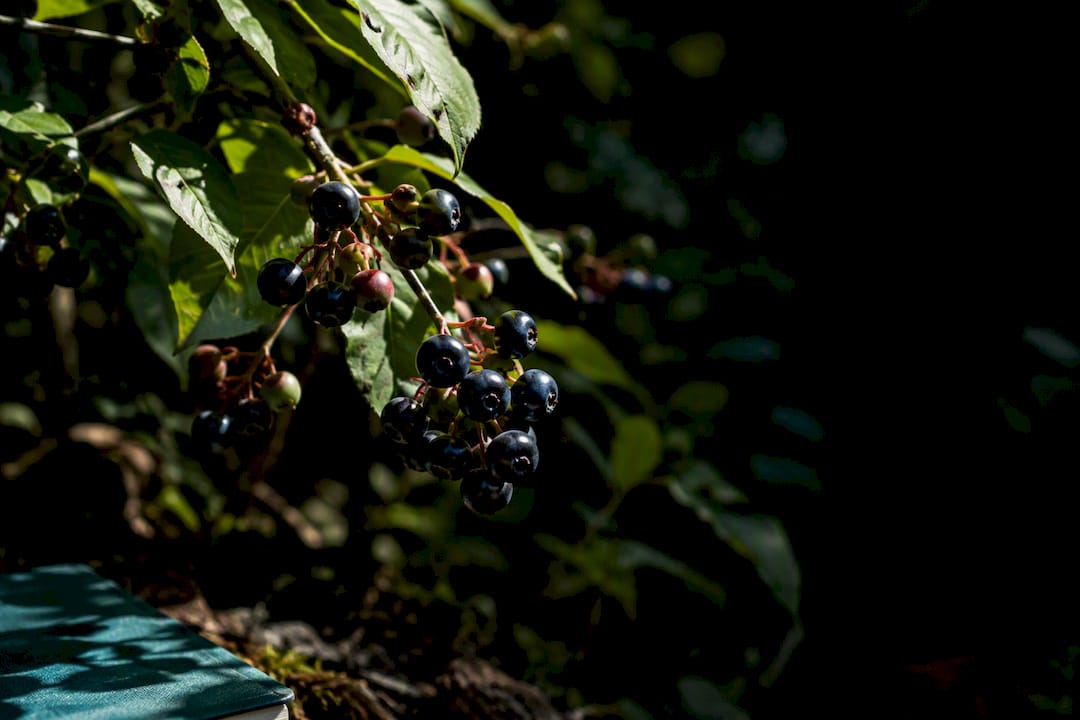
Identify the plant, not the berry. Aggregate drupelets like blackberries and raspberries are almost always safe to eat, while single smooth berries growing on non-thorny plants carry far higher risk. If you or a child eats an unknown berry, call Poison Control immediately at 1-800-222-1222, save a sample of the plant, and never induce vomiting unless a professional tells you to.
TL;DR:
Identifying the plant structure, such as aggregate drupelets or specific stem and leaf features, is more reliable than relying on berry color alone.
Cross-check multiple sources, including apps and printed guides, before consuming any wild berry, and never taste an unknown berry for identification.
The most dangerous lookalikes for accidental poisoning—baneberry, yew, and deadly nightshade—are common in yards, parks, and often resemble safe berries from a distance.
Raw elderberries and other parts of edible plants like elderberry require cooking to avoid gastrointestinal upset or toxicity.
Calling Poison Control immediately is critical if someone ingests an unknown berry, and always retain a plant sample for proper identification.
Table of Contents
Common Poisonous Berries to Know
Color tells you almost nothing useful. A red berry can be a raspberry or it can be baneberry, and the difference between “snack” and “emergency room” comes down to structure, growth habit, and what’s attached to the stem. Orvik’s identification guidance makes this point bluntly: color alone is one of the least reliable features you can use, and multiple-feature checks beat single-glance judgments every time.
Here’s the shortlist that causes most accidental poisonings in North America, according to foraging and extension resources tracking common lookalike incidents:
White and red baneberry (Actaea spp.) grow in small clusters on herbaceous stems in shaded woodlands. The white variety has a distinctive black dot on each berry, earning it the nickname “doll’s eyes.” Both types contain cardiogenic toxins that cause cardiac arrest in high enough doses, and they’re especially dangerous to children who find the white berries visually appealing.
Pokeweed (Phytolacca americana) produces dark purple-black berries in long, drooping clusters on a plant with a signature magenta stem. The whole plant is toxic, though birds eat the ripe berries without issue. Ingestion causes severe gastrointestinal distress and can affect the nervous system in larger amounts.
Deadly nightshade (Atropa belladonna) bears shiny black berries singly or in small groups, usually on a bushy, branching plant. It contains atropine and related alkaloids, and just a few berries can be fatal for a small child. This is one of the most dangerous lookalikes in the entire list.
Yew (Taxus spp.), a common landscaping shrub, produces bright red, fleshy arils around a single hard seed. The seed and foliage contain taxine alkaloids that disrupt heart rhythm. The red flesh itself is less toxic, but the seed inside is not, and children chewing through it is the real danger.
Holly (Ilex spp.) grows red or black berries in small clusters against glossy, spiny leaves, a plant most people recognize from holiday decorations. The berries cause vomiting and diarrhea rather than systemic poisoning, but enough of them can still land a kid in urgent care.
Lily of the valley (Convallaria majalis) produces small orange-red berries on a low, shade-loving plant with broad basal leaves and no woody stem at all. Every part of the plant contains cardiac glycosides similar to digoxin, and even the water in a vase holding cut stems can carry enough toxin to cause symptoms.
Bittersweet nightshade (Solanum dulcamara) climbs as a sprawling vine and produces oval red berries that ripen from green, often shown with the purple star-shaped flowers still nearby. It’s a cousin of the tomato and potato family, and the unripe green berries are the most concentrated with solanine.
Moonseed (Menispermum canadense) climbs on tendrils and produces blue-black berries that closely mimic wild grapes. The giveaway is inside: a single crescent-shaped seed instead of the round seeds you’d find in a grape. Ingestion causes convulsions in serious cases.
Buckthorn (Rhamnus spp.) grows small black berries in clusters along a shrub or small tree with thorny branchlets and finely toothed leaves. The berries act as a strong laxative and can cause severe cramping and dehydration in quantity.
English ivy (Hedera helix) produces small black berries in rounded clusters at the tips of its climbing vines, usually late in the season. The berries cause vomiting, abdominal pain, and skin irritation on contact with the sap.
If you remember only three names from this list, make them belladonna, yew, and white baneberry. All three show up in yards and parks as often as in true wilderness, and all three pose the highest risk specifically to small children, who are drawn to bright colors and put things in their mouths before anyone can stop them.
Safe Wild Berries Beginners Should Learn First
Learning to forage safely starts with narrowing your focus, not widening it. Farmers’ Almanac’s berry identification guidance recommends mastering a handful of edible genera before venturing into anything unfamiliar, because these groups have very few dangerous native lookalikes in North America.
Blackberries and raspberries (Rubus spp.) are aggregate fruits made of tiny individual drupelets clustered around a central core, growing on thorny canes. Raspberries pull away hollow when picked; blackberries keep their white core attached. This structure alone rules out almost every dangerous species on the list above.
Blueberries and huckleberries (Vaccinium spp.) grow on low woody shrubs and show a small five-pointed “crown” remnant on the blossom end of each berry, a leftover from the flower. No dangerous native lookalike shares that crown mark.
Wild strawberry is easy to confirm by the plant itself: three-leaflet leaves, low ground-hugging growth, and a fruit covered in tiny visible seeds rather than one embedded pit.
Serviceberry grows on a small tree or shrub and shares that same star-crown feature seen on blueberries, making it simple to cross-check once you know what to look for.
Rose hips form on thorny bushes and keep the dried remains of the flower’s sepals attached at the tip, like a tiny crown of dried petals. That persistent structure is the identifying feature.
Elderberry deserves its own line, because it’s the one common edible with a real caveat: raw elderberries and other raw parts of the plant cause gastrointestinal upset and should never be eaten uncooked. Cook them into syrup, jam, or pie first. If you’re starting from zero, focus on Rubus and Vaccinium before anything else. Those two genera cover most of what you’ll actually encounter on a trail and give you a confident baseline before you tackle harder species.
Field Checklist Before You Pick or Taste Anything
Treat every unfamiliar berry patch the same way, in the same order, every time. Skipping a step is how confident foragers end up making bad calls.
Step 1: Look at the whole plant from a distance first. Note whether the berries grow as tight aggregate clusters (like a blackberry) or as single, individually attached fruits. Photograph the entire plant, not just the fruit, before you touch anything.
Step 2: Check the leaves and stem type. Is it a thorny cane, a smooth climbing vine, a woody shrub, or a soft herbaceous stem with no bark at all? Look for any leftover flower parts, like a persistent calyx or sepals, still attached to the fruit.
Step 3: Test how the berry detaches. Raspberries release hollow from their core; blackberries keep the white core attached when pulled. Check stem color too. Pokeweed’s magenta stalk is a dead giveaway, and baneberry’s translucent, almost glassy-looking berries stand apart from the duller, matte surface of true edibles.
Step 4: Cross-check with more than one source before you eat anything. Run a photo through an app, then confirm against a printed regional field guide or your state extension page. If the two don’t agree, don’t eat it.
Don’t trust bird activity as a safety signal. Birds regularly eat berries that are toxic to humans without any ill effect, since their digestive systems process certain toxins differently than ours do. “The birds are eating it” has sent more than one confident forager to the emergency room.
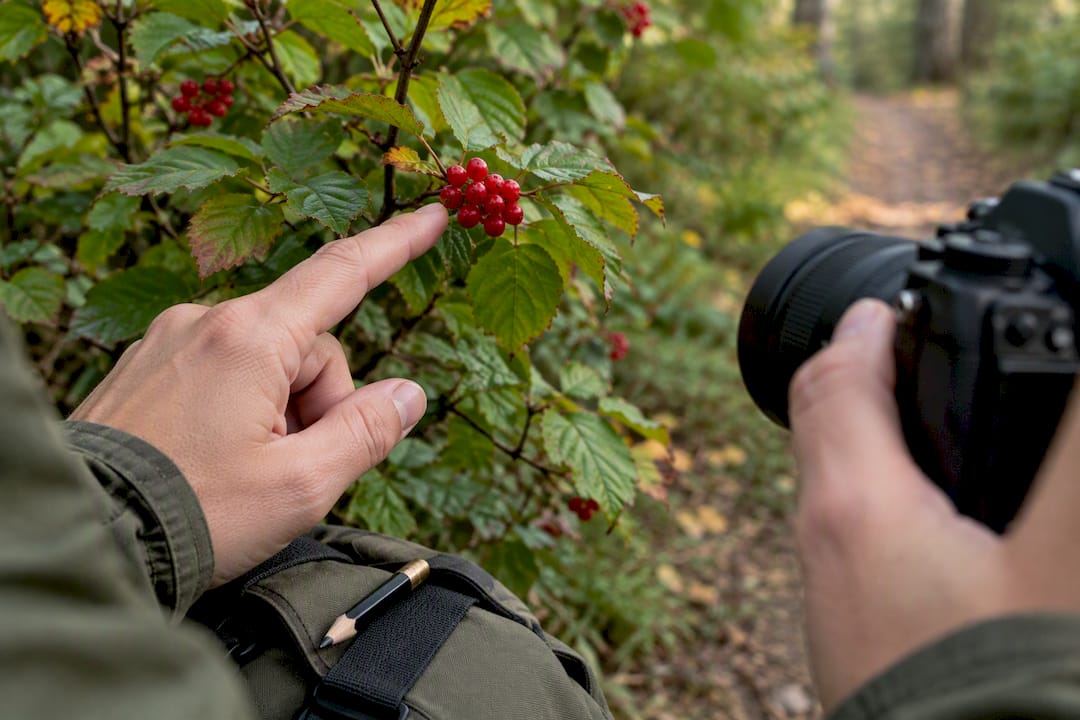
Pro Tip: Carry a pencil or hold up a fingertip next to the berry when you photograph it. Scale reference in the photo makes it much easier to confirm size later against a field guide description, and it takes two extra seconds in the field.
Lookalikes That Send People to the ER
Most poisoning scares trace back to a small number of confusions, not an endless list of obscure plants. Knowing these four pairs cold will cover the majority of real-world mix-ups.
Blackberry vs. deadly nightshade or other single-berry lookalikes. A true blackberry is an aggregate of drupelets around a solid white core and grows on a thorny cane. A single glossy berry on a smooth, non-thorny stem with no aggregate structure is an automatic red flag, no matter how much it resembles a blackberry from a distance.
Elderberry vs. pokeweed. Elderberry grows as a multi-stemmed shrub with flat-topped clusters of small berries and a woody, tan stem. Pokeweed’s berries hang in long drooping racemes off a smooth, distinctly magenta stalk. That stem color difference is the fastest way to tell them apart, even before you look at the fruit.
Wild grapes vs. moonseed. Both climb using tendrils and produce blue-black fruit in loose clusters, which makes this one of the trickiest pairs on the list. Cut a berry open. Wild grape seeds are round to oval; moonseed carries a single, distinctly crescent-shaped seed. Don’t taste either one until you’ve confirmed the seed shape.
Rose hips vs. lily of the valley berries. Rose hips form on a thorny, upright bush and keep dried sepal remnants attached at the tip like a small crown. Lily of the valley grows low to the ground with broad basal leaves and no thorns anywhere, and its orange-red berries lack that persistent flower structure entirely.
Aggregate versus single-berry structure remains the single most useful shortcut a beginner can learn, and it’s one you can teach visually on a single walk through your own backyard.
Apps, Field Guides, and Extension Sites: Using Digital Tools Safely
Treat identification apps as a first pass, never a final answer. The safest workflow starts with a photo run through an app like iNaturalist, Seek, or Orvik’s wild-berry identifier, which returns a list of candidate species. From there, verify that candidate against a written regional source before you go anywhere near tasting it.
Run the photo through an app to generate a shortlist of likely candidates.
Cross-check the top candidate against a printed field guide (Peterson and Newcomb guides remain standard references for North American plants) or a state extension page.
Confirm botanical details and regional distribution using the USDA PLANTS database, which maintains species profiles and range maps for exactly this kind of verification.
If the app result and the written guide disagree, or if you’re still unsure after both checks, don’t eat it.
Apps genuinely speed up identification, but they still produce false positives often enough that the safest approach pairs an app suggestion with a regional guide and, ideally, a second person’s confirmation.
Poison Control fields calls related to plant and berry ingestions every year, most involving young children who found something in a yard rather than deep in the woods. The national hotline, 1-800-222-1222, is staffed around the clock and should be the first call, not a last resort, any time ingestion is even a possibility.
What to Do If Someone Eats an Unknown Berry
Speed and accurate information matter more than anything else in the first few minutes.
Call Poison Control at 1-800-222-1222 right away. Don’t wait to see if symptoms appear, and don’t induce vomiting unless a professional on the line specifically tells you to.
Collect a plant sample. Cut a shoot with leaves, stem, and fruit attached, seal it in a bag, and take clear photos of the plant growing in its original spot.
Write down the details poison control will ask for: the time of ingestion, an estimate of how many berries were eaten, the person’s age and approximate weight, and any symptoms you’ve noticed so far.
Call 911 instead if symptoms are severe. Trouble breathing, seizures, or loss of consciousness need emergency services immediately. Poison Control is for triage and guidance; 911 is for a crisis already unfolding.
Keeping a basic first aid kit on hand during any hike or backyard outing makes this process faster when it counts.
Why This Guide Holds Up: Sourcing and Verification
This guide draws on field-tested identification rules used by working foragers, cross-checked against the USDA PLANTS database for botanical accuracy and against poison control protocols for the emergency steps. Author S compiled it using internal safety research and case notes gathered from outdoor education work.
The core rules repeated throughout this guide aren’t opinion. They reflect consistent recommendations from multiple independent sources:
Identify the plant structure, not just berry color.
Cross-check at least two sources (an app plus a written guide) before eating anything wild.
Never taste an unknown berry to “test” it.
Call Poison Control at 1-800-222-1222 immediately if ingestion happens.
For anything specific to your region, a state extension service will always know local species distribution better than a national guide can.
Field-Tested Habits That Keep Families Safe
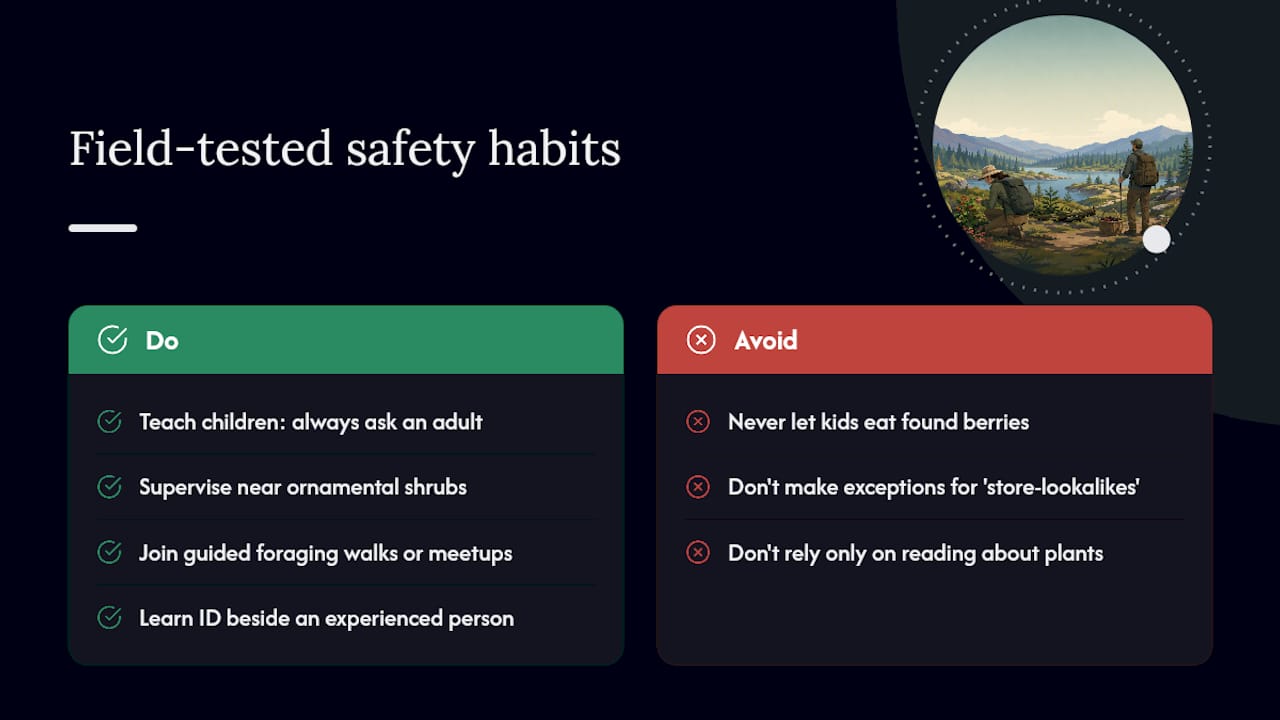
The single habit that prevents the most accidents costs nothing: teach kids to ask an adult before eating anything they find outside, full stop, no exceptions for berries that “look just like the ones at the store.” Supervise closely around ornamental shrubs in your own yard, since holly, yew, and lily of the valley show up in landscaping far more often than in true wilderness.
Beyond that, the fastest way to build real identification skill is a guided foraging walk or a local native-plant society meetup. Nothing replaces having someone point at a live plant and say “this one, not that one.” Reading about baneberry is useful. Standing next to it with someone who’s identified it a hundred times is how the knowledge actually sticks.
— S
Keep Building Your Outdoor Safety Skills
Berries are just one piece of staying safe outdoors, and this guide aims to cover the rest of that picture with the same field-tested, no-fluff approach: practical checklists over generic advice, written by people who actually spend time outside rather than repackaging someone else’s blog post.

If this checklist helped, browse Thrillofit’s other identification guides on poisonous plants, poison sumac, and wild edible plants before your next trip out. Head to the Thrillofit homepage to find the full library of safety and survival guides organized by topic, so the next question you have on trail already has an answer waiting.
Sources
FAQ
What Is the Most Common Poisonous Berry?
Pokeweed and baneberry account for a large share of accidental exposures in North America, largely because both grow in yards, parks, and roadsides rather than remote wilderness. Pokeweed’s magenta stem makes it identifiable at a glance once you know to look for it.
Are the Small Red Berries in My Yard Poisonous?
It depends entirely on the plant, not the color. Holly, yew, and lily of the valley all produce red or red-orange berries and are common landscaping plants, and all three require caution, especially around children. Check the leaf shape, stem type, and cluster pattern before assuming anything is safe.
Are There Poisonous Berries That Look Like Blackberries?
True blackberries form as an aggregate of drupelets around a solid core on a thorny cane, a structure that most dangerous species don’t share. Some single-berry species can appear similar from a distance, which is why checking the aggregate structure up close, rather than just the color, matters more than a quick glance.
What Berries Are Not Safe to Eat?
Baneberry, pokeweed, deadly nightshade, yew, holly, lily of the valley, bittersweet nightshade, and moonseed are among the berries you should never eat. Raw elderberries also fall into this category since they require cooking first to be safe.
Will Eating an Unknown Berry Make Me Sick?
It depends on the species and quantity, ranging from mild stomach upset to a genuine medical emergency. If ingestion happens, call Poison Control at 1-800-222-1222 right away rather than waiting to see whether symptoms appear.
Recommended
Comments