

The Role of Awareness in Survival: A Field Guide
- Wesley Coldwell
- 19 hours ago
- 12 min read
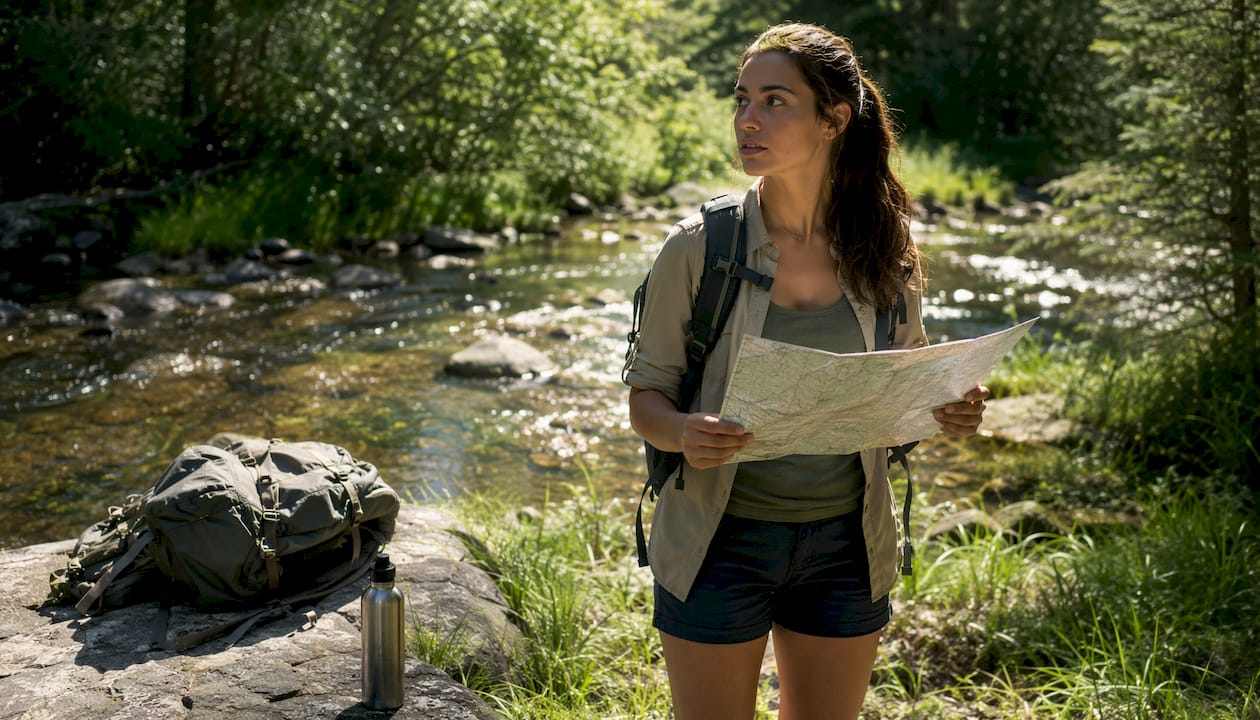
TL;DR:
Situational awareness is a vital survival skill that preserves options and buys time by detecting environmental changes. Developing this skill involves simple daily practices like counting exits and building mental baselines in new environments. Training mental frameworks such as the OODA Loop, Cooper Color Code, and the 3-3-3 Rule enhances decision-making and effective responses under pressure.
Awareness is your first survival tool. Before shelter, fire, or a first-aid kit does anything for you, awareness tells you when to use them. The core claim is simple: situational awareness preserves your options and buys you time by letting you perceive changes in your environment, understand what they mean, and project where they are heading. Miss that window, and every other skill you have arrives too late.
Start right now, with zero equipment:
Adopt Condition Yellow: relaxed alertness, eyes up, phone in your pocket.
Count the exits in whatever room or space you are in.
Pause 60 seconds when you enter a new environment and build a mental baseline.
Note three things: hands (what people are doing with them), eyes (where attention is directed), exits (how many, how far).
Pro Tip: Put your phone away during every transition — parking lots, trailheads, building entrances. Those are the moments when threats materialize and most people are looking at a screen.
Table of Contents
What does situational awareness actually mean?
Situational awareness (SA) is a trainable cognitive skill, not a personality trait you either have or lack. The most widely used operational definition, developed by researcher Mica Endsley, breaks it into three sequential levels:
Perception — detecting relevant elements in your environment (sounds, movement, exits, weather shifts, other people’s behavior).
Comprehension — understanding what those elements mean right now given your goals and context.
Projection — anticipating how the situation will change in the near future so you can act before it forces your hand.
Most people operate at Level 1 on a good day. The gap between Level 1 and Level 3 is where accidents happen.
SA also includes internal signals. ALARM theory frames primordial sensations like pain, fear, and gut unease as evolved biological signals, not noise to suppress. Your body is part of your sensor array. Ignoring a sudden spike of anxiety in a parking garage is the same mistake as ignoring an unusual sound on a trail.
The practical mental model: baseline → deviation → response. Establish what normal looks like, notice when something breaks that pattern, then decide.
Pro Tip: Sensory awareness goes beyond vision. Train yourself to notice ambient sound levels, temperature shifts, and your own heart rate. When one of those changes without an obvious cause, treat it as a Level 1 signal worth investigating.
Why awareness is the foundation of every survival outcome
SA failure is a documented contributing factor in catastrophic accidents across aviation, wilderness emergencies, and personal security incidents. The Civil Aviation Authority of New Zealand’s safety guidance identifies it explicitly as a recurring causal element in serious incidents — and the same pattern appears in search-and-rescue case reviews and accident investigations across the U.S.
The reason is mechanical: early detection multiplies your options. Spot a threat at 200 yards and you have time to change routes, call for help, and prepare. Spot it at 10 feet and your only option is reaction. Every second of advance notice converts directly into choices.
Three concrete ways awareness changes outcomes:
Prevents escalation. A hiker who reads deteriorating weather cues at noon turns back before conditions become life-threatening. One who notices at 3 PM is managing a crisis.
Reduces panic. People who have pre-mapped exits and rehearsed responses act faster and with less cognitive freeze when a real threat appears.
Preserves physical resources. Awareness of early dehydration, fatigue, or hypothermia symptoms lets you address them before they compound. The Mayo Clinic notes that hypothermia impairs judgment before it impairs movement — meaning you lose awareness before you lose mobility, which is exactly why catching it early matters.
Self-awareness of internal states shortens the gap between stress impact and deliberate response. Tracking your own reactions — elevated heart rate, shallow breathing, tunnel vision — makes the difference between a considered decision and an automatic one you regret.

Which mental frameworks help you act under pressure?
Three models cover most survival scenarios. Each operates on a different timescale and serves a different purpose.
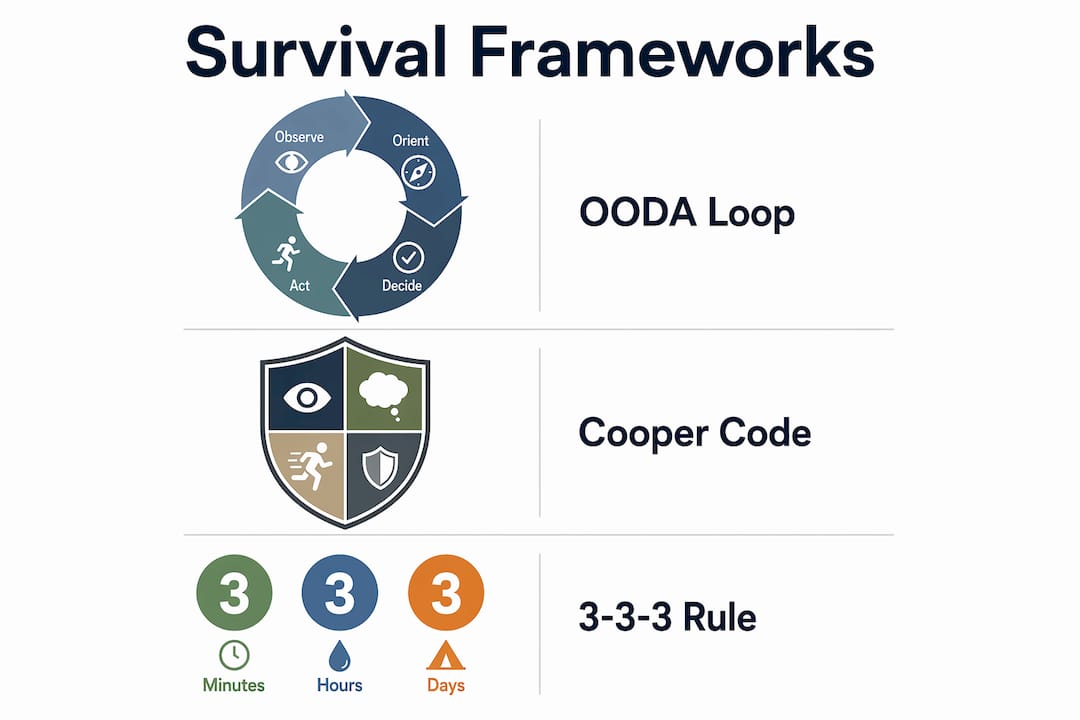
OODA Loop
Developed by military strategist John Boyd, OODA stands for Observe, Orient, Decide, Act. For an individual in the field, it works like this:
Observe: gather raw sensory data (what do you see, hear, feel?).
Orient: filter it through your experience, training, and current context.
Decide: choose a course of action from your available options.
Act: execute, then loop back to Observe.
The OODA Loop is not a slow deliberate process — it is a cycle you can shorten dramatically through rehearsal. Pre-populating your Orient phase with practiced responses (checklists, mental rehearsal, scenario practice) means you spend less time deciding and more time acting when seconds count.
Cooper Color Code
Developed by Lt. Col. Jeff Cooper, this model assigns mental states to colors:
White: unaware, unprepared. Asleep or distracted.
Yellow: relaxed alertness. Your default operating state in public.
Orange: specific alert. Something has drawn your attention; you are forming a plan.
Red: active response. A threat is confirmed; you are executing.
The recommended default is Condition Yellow. It is sustainable, non-paranoid, and keeps your perception active without burning you out.
The 3-3-3 Rule
A field triage heuristic for immediate survival priorities: it prioritizes urgent needs such as air, shelter in harsh conditions, and water, forcing you to sequence your responses by actual urgency rather than emotional salience. Awareness feeds directly into it — you cannot prioritize correctly if you have not assessed your environment.
Framework | Primary Purpose | Timescale | Best Use |
OODA Loop | Decision cycle under pressure | Seconds to minutes | Active threat, fast-moving situation |
Cooper Color Code | Baseline mental state management | Ongoing / daily | Maintaining sustainable alertness |
3-3-3 Rule | Survival priority sequencing | First hours of a crisis | Wilderness emergency, immediate triage |
Pro Tip: Under high stress, the OODA Loop tends to stall at Orient because your brain is flooded with input. Switch to the 3-3-3 rule to force a priority sequence, then return to OODA once you have stabilized.
How does awareness break down, and what can you do about it?
Awareness does not fail all at once. It degrades through specific, predictable mechanisms.
Tunnel vision / fixation: you lock onto one element and stop perceiving everything else. Common under stress. Mitigation: force a deliberate scan every 30 seconds; name what you see out loud if possible.
Confirmation bias: you interpret new information to fit your existing assumption. Mitigation: actively look for evidence that contradicts your current read of the situation.
Phone distraction: screen use during transitions suppresses peripheral vision and auditory attention simultaneously. Mitigation: phone goes away before you enter any transition space.
Auditory exclusion: under adrenaline, your brain filters out sounds it deems non-threatening. You may not hear a warning shout. Mitigation: train with noise present; practice identifying sounds without visual confirmation.
Sleep deprivation: even moderate sleep loss degrades perception accuracy and slows comprehension. A tired person operating at Level 1 SA thinks they are at Level 2. Mitigation: treat sleep as a tactical resource, not a luxury.
Cognitive overload: too many simultaneous tasks collapse SA to the most immediate one. Mitigation: use checklists to offload working memory so your attention stays on the environment.
Common training errors in high-performance contexts often mirror these failure modes — overloading attention during practice, skipping baseline checks, and underestimating fatigue’s effect on perception.
Pro Tip: When you catch yourself thinking “everything is fine” without having actually scanned the environment, that is confirmation bias in action. Name it. Then look again.
Concrete drills you can start this week
Awareness is a skill, which means it responds to deliberate practice. These drills require no gear and fit inside a normal day.
Daily micro-practices
Exit count: every time you enter a building, count exits before you sit down. Takes five seconds.
People description: pick one stranger and mentally describe them (height, clothing, gait, direction of travel). Do this twice a day.
Parking-lot pause: before you get out of your car, spend 15 seconds scanning the lot. Note anything that seems out of place.
Phone-free transitions: no screen use while moving between spaces.
The 60-second baseline pause
On entering any new environment — a trailhead, a venue, a parking structure — stop and spend 60–90 seconds building a mental baseline. Ask: What is the ambient noise level? How many people, and where are they moving? What are the exits? What feels off? This single habit dramatically improves your ability to detect deviations later.
Kim’s Game
A classic military memory drill. Place 10–15 objects on a table, study them for 60 seconds, cover them, and write down as many as you can. Do it weekly. It trains rapid perception and short-term environmental encoding — the exact cognitive process you use when scanning a new space.
A 4-week progression
Week 1: Exit counting and parking-lot pause, every day.
Week 2: Add the 60-second baseline pause at every new location.
Week 3: Add people description (two strangers per day) and Kim’s Game once.
Week 4: Add a 10-minute mental rehearsal scenario: pick a location you visit regularly and walk through a “what if” response in your head.
Self-awareness tracking of your internal state belongs in every drill session. Before you start, note your fatigue level and stress level. After, note whether your perception felt sharp or sluggish. Over four weeks, patterns emerge.
Pro Tip: Stack drills onto existing habits. Do the parking-lot pause every time you arrive somewhere, not as a separate exercise. Habit stacking is how micro-drills become automatic.
Your immediate-response checklist when something feels wrong
When your awareness flags a potential threat, sequence matters. Fastest, highest-impact steps first.
Detect → Distance → Cover → Communicate → Exit
Detect: confirm the threat is real. Scan, do not fixate. Use all senses.
Create distance or cover: move away from the threat or put a solid object between you and it. Do not wait for certainty.
Communicate: alert others nearby; call 911 if warranted. A brief, clear message beats a long one.
Exit: identify and move toward the nearest viable exit. Know it before you need it.
Reassess: once you are at a safer position, run the 3-3-3 rule to triage your next priorities.
Survival priority quick-reference (7 priorities condensed):
Positive mental attitude
First aid (treat life-threatening injuries immediately)
Shelter (from environmental threats)
Fire (warmth, signaling, water purification)
Signaling (let rescuers find you)
Water
Food (last priority in most short-duration emergencies)
If you notice X, do Y:
Crowd suddenly moving in one direction → move perpendicular, not with the flow; find cover.
Someone tracking your movement → change direction twice; enter a public space.
Weather deteriorating rapidly → stop, shelter, signal. Do not push on.
You feel sudden unexplained dread → treat it as a Level 1 signal; scan immediately.
Pro Tip: Print this checklist and keep it in your go-bag or trail pack. Reading it once a month takes 90 seconds and keeps the sequence fresh without requiring active memorization.
How to apply these techniques across different environments
The same three-level model (perceive, comprehend, project) applies everywhere. What changes is what you are looking for.
Wilderness
Environmental baselines dominate. Learn what “normal” looks like for the terrain and season: typical bird activity, wind patterns, trail conditions, your partners’ energy levels. Deviations — sudden silence, a partner slowing without explanation, clouds building from the west — are your signals. Navigation skills and route reconnaissance are awareness tools, not just logistics. Knowing where you are relative to shelter, water, and exit routes is projection in practice.
Urban
Focus on crowd flow and transition points. Venues, transit stations, and parking structures are where SA most often fails because people mentally “arrive” before they have actually scanned. Count exits before you sit. Note who is near the doors. In a crowd, watch for counter-flow movement — someone moving against the crowd’s direction often signals a problem the crowd has not yet registered.

Vehicle
Develop an approach and egress routine. Before you get out, scan the immediate area. Park where you can pull forward rather than reverse out. Keep doors locked until you have confirmed the space is clear. In traffic, maintain enough following distance to have an exit option if the vehicle ahead stops suddenly.
Active threat
This is where the Cooper Color Code earns its keep. You want to be in Yellow before anything happens, move to Orange the moment something specific draws your attention, and reach Red only when a threat is confirmed. The transition from Yellow to Orange is where most people freeze — they do not want to be wrong. Train yourself to act on Orange without waiting for Red-level certainty.
Pro Tip: In any new environment, identify two exits within the first 60 seconds. This single habit covers wilderness, urban, and vehicle contexts equally.
Where to get real training in the U.S.
Reading about awareness builds knowledge. Scenario-based practice builds the skill. These are the most accessible, credible starting points in the United States.
Foundational courses:
American Red Cross first aid and CPR courses teach you to recognize physiological distress signals in yourself and others — a direct application of Level 1 SA. They are available in-person and online across the country.
Local Search and Rescue (SAR) volunteer programs run scenario-based training that is among the most realistic available to civilians. Contact your county sheriff’s office to find your nearest team.
Defensive awareness and personal safety courses (offered through many community colleges, law enforcement agencies, and martial arts schools) combine physical skills with the mental models covered here.
Selection criteria for any course:
Evidence-based curriculum with scenario practice, not just lecture.
Instructors with verifiable field or operational credentials.
Drills that simulate stress (time pressure, noise, incomplete information).
Clear liability and insurance disclosures.
Apps and tools that support awareness without creating distraction:
Offline mapping apps (such as Gaia GPS or onX) reduce the cognitive load of navigation so your attention stays on the environment.
Weather alert apps (NOAA Weather Radar, Weather Underground) extend your projection window for environmental threats.
Emergency communication devices (Garmin inReach) give you a signaling option that does not require a cell signal.
The rule for all of these: configure them before you enter the field, not during. A phone you are actively operating is a phone that is degrading your awareness. Pair your emergency signaling preparation with your awareness training so both become part of the same pre-departure routine.
Injury prevention in high-demand physical contexts follows the same logic. Tactical athlete training guidance emphasizes recognizing baseline patterns and hazard signs before they become injuries — the same perceive-comprehend-project cycle applied to your own body.
Key Takeaways
Awareness is the one survival skill that activates every other skill you have — without it, your gear, training, and plans sit idle until it is too late.
Point | Details |
Perceive, comprehend, project | SA operates in three levels; most people stop at Level 1 — train all three deliberately. |
Default to Condition Yellow | Relaxed alertness is sustainable; constant high-alert scanning burns out and fails. |
60-second baseline pause | Entering any new environment, stop and build a mental baseline before moving on. |
OODA Loop shortens under rehearsal | Pre-populate your Orient phase with scenario practice so decisions happen faster under stress. |
Thrillofit survival guides | Thrillofit’s field guides on navigation, signaling, and wilderness self-reliance extend these drills into specific outdoor contexts. |
The habit that actually changed how I move through the world
Most people treat situational awareness as something you switch on when things feel dangerous. That framing is exactly backward. By the time something feels dangerous, you have already lost the window where awareness does its best work.
The single most underrated shift is not learning the OODA Loop or memorizing the Cooper Color Code. It is the 60-second baseline pause. Doing it consistently, in mundane places — a coffee shop, a trailhead parking lot, a hotel lobby — builds the mental template library that makes deviations register automatically. You stop having to think about it. The deviation just stands out.
What most guides miss is the internal dimension. Tracking your own fatigue, stress level, and emotional state before you enter a demanding environment is not soft psychology. It is calibration. A tired, stressed person running on Condition Yellow is actually operating at something closer to White. Knowing that lets you compensate.
Start with one habit. Count exits today. Do it for two weeks until it is automatic. Then add the baseline pause. Stacking small, specific habits beats trying to overhaul your entire attentional style at once. The goal is not vigilance. The goal is a practiced, calm, reliable read of whatever environment you are in.
Build your awareness practice with Thrillofit
Knowing the frameworks is step one. Putting them into field-ready habits is where most people stall. Thrillofit’s guides on wilderness self-reliance and outdoor navigation give you the context-specific drills and checklists that turn this article’s mental models into repeatable routines for real environments.
Whether you are preparing for a backcountry trip, building a personal safety routine, or working through a structured skills progression, the guides at Thrillofit cover the practical side: what to carry, how to move, and how to read the environment before it reads you. Head to Thrillofit to find the guide that fits your next outing and start one drill today.
Useful sources
Civil Aviation Authority of New Zealand — Situational Awareness Guidance: The most thorough operational breakdown of SA failure modes and building strategies; directly applicable beyond aviation to any high-stakes environment.
Wikipedia — Situation Awareness: Solid overview of Endsley’s three-level model with cross-domain citations; good starting point for theory.
Modern Warrior Project — Situational Awareness: The Skill That Keeps You Alive: Practical breakdown of Cooper Color Code and OODA Loop with field application; reliable for mental model training.
Survipedia — Situational Awareness: Covers the 60–90 second baseline pause and mental rehearsal techniques with concrete drill guidance.
Mind4Survival — Situational Awareness Training: Addresses sustainable awareness habits and how to avoid burnout from constant high-alert scanning.
American Red Cross Learning Center: The primary U.S. resource for first aid and CPR certification; courses build physiological awareness skills directly applicable to field emergencies.
Fuller Life Family Therapy — Self-Awareness: Staying Awake: Explains how tracking internal states shortens the gap between stress impact and deliberate response.
ALARM Theory — PMC: Biological basis for internal awareness signals; supports the case for treating bodily sensations as survival data.
Recommended