

The Role of Cordage in Survival: A Paracord Field Guide

Updated: Sep 5
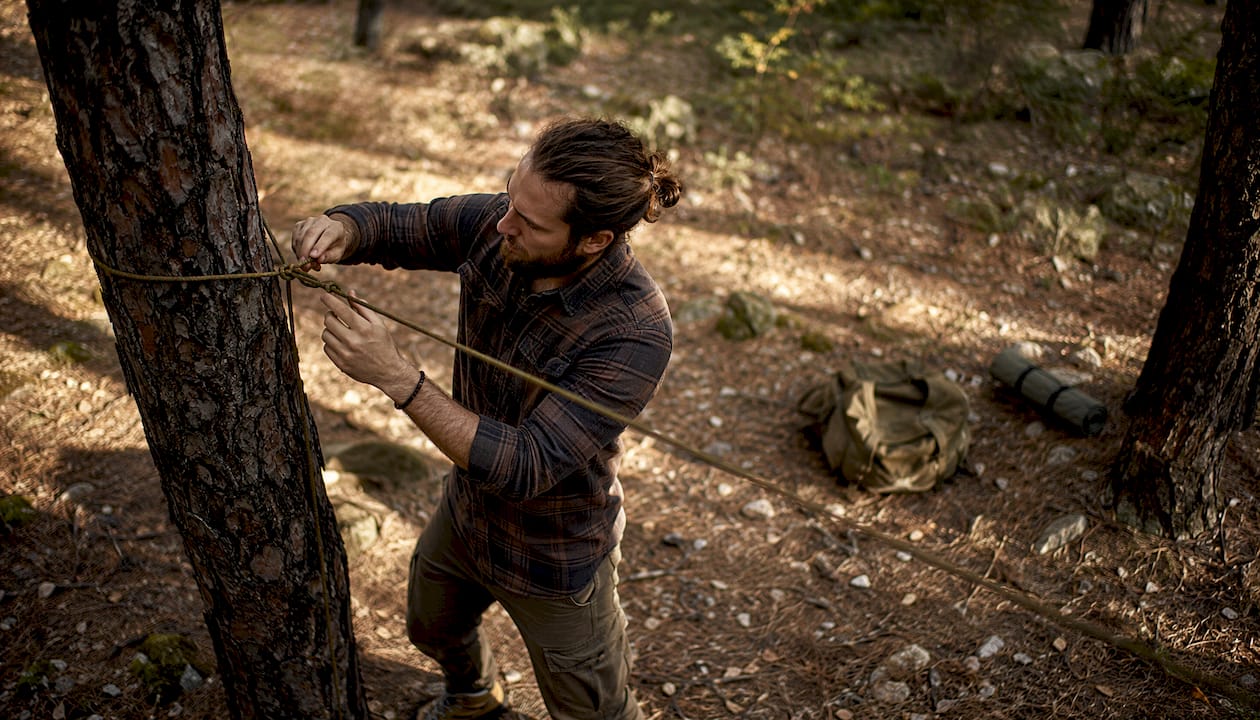
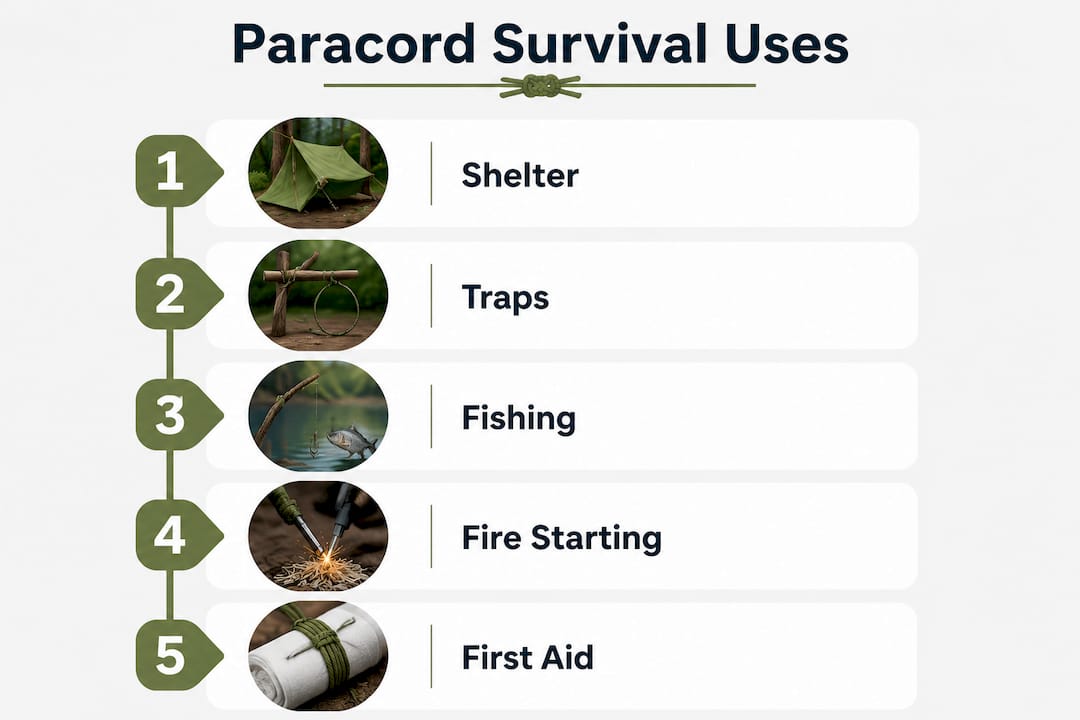
Cordage is the single most versatile tool you can carry into the wilderness. Without it, shelter construction stalls, gear repairs become improvised guesswork, and food procurement drops to whatever you can catch by hand. With it, you can rig a tarp ridgeline, set a snare, splint a broken limb, and lash together a raft. The role of cordage in survival is not a supporting one. It is foundational. Paracord, specifically 550 paracord, has become the go-to choice for most survivalists because it combines tensile strength with a compact, lightweight form that fits in any kit. A length of paracord can hold sufficient weight for many survival uses and still break down into inner strands fine enough to use as fishing line or sewing thread.
The core survival functions cordage covers:
Shelter: Ridgelines, tarp tie-outs, lashing poles, tensioning guy lines
Gear repair: Replacing broken straps, re-lacing boots, securing pack frames
Food procurement: Snare lines, fishing line, trap triggers, bow drill strings
Medical aid: Improvised splints, tourniquet windlasses, securing dressings
Signaling: Suspending signal panels, hanging mirrors or flags at height
Navigation and movement: Negotiating cliffs, river crossings, fixed hand lines
1. How to build a shelter with paracord
Shelter is the first priority in most survival scenarios, and paracord handles every structural task. Tie a ridgeline between two trees using a taut-line hitch on one end and a bowline on the other. The taut-line hitch lets you adjust tension without retying, which matters when your tarp sags after rain. For a lean-to, lash horizontal poles to vertical uprights using a square lashing: wrap the cord around the junction four times, then cinch it with two frapping turns pulled tight. The result holds under load far better than a simple wrap-and-knot.
For a more detailed breakdown of construction methods, Thrillofit’s guide on building a survival shelter covers frame types and anchoring techniques worth knowing before you need them.
2. Setting snares and traps
Paracord’s inner strands, each rated for light loads, are ideal for snare loops. Strip the outer sheath and pull out one or two inner strands. Twist them together for a snare line that is fine enough not to alarm small game but strong enough to hold a rabbit or squirrel. The fixed loop of a simple wire-style snare can be replicated with a twisted inner strand by forming an overhand loop and passing the tag end back through. Position the loop at the animal’s head height on a well-used trail, anchored to a stake with a clove hitch.
For heavier game, use the full outer sheath. A spring snare requires a trigger notch and a bent sapling; paracord connects the trigger to the snare loop and handles the tension without stretching out of shape.
3. Fishing line and net making
The inner strands of 550 paracord double as functional fishing line in a pinch. Each strand is thin enough to be nearly invisible in water and strong enough to land most freshwater fish you would realistically encounter. Tie a hook using an improved clinch knot, which cinches tighter under load rather than slipping. For a gill net, weave multiple inner strands between two parallel cordage lines using a series of half hitches spaced a few inches apart. It takes time, but a net dramatically increases your catch rate compared to a single line.
4. Fire starting with a bow drill
A bow drill requires a taut, durable string that can withstand sustained friction without snapping. Paracord’s outer sheath works well here. Wrap it once around the spindle and pull the bow back and forth with steady, even strokes. The cord grips the spindle without slipping, which is the most common failure point with improvised strings. Natural cordage made from dogbane or nettle also works, but it requires more preparation time and breaks more easily under the heat and friction of a long drilling session.
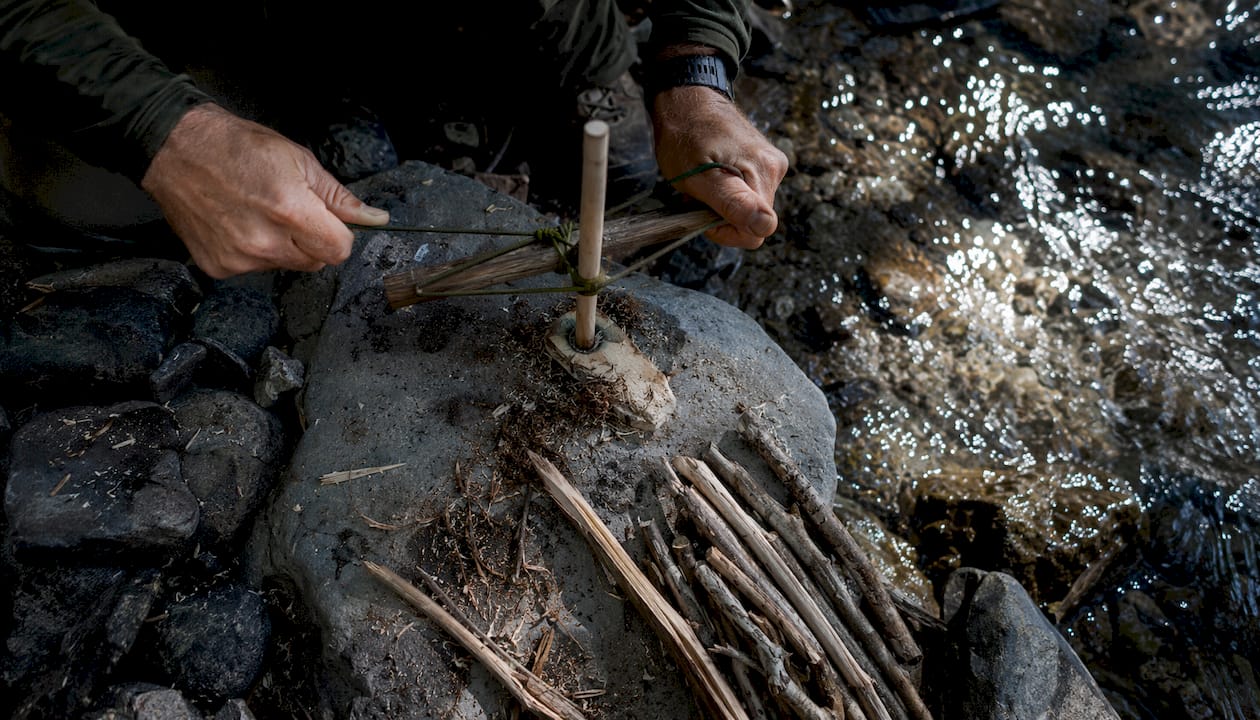
Pro Tip: Slightly wax the bow string with pine pitch or lip balm before drilling. It reduces friction on the bow itself while maintaining grip on the spindle.
5. First aid applications
Cordage shows up in wilderness first aid more often than most people expect. A rigid splint needs to be secured to the injured limb, and paracord wrapped in a figure-eight pattern around the splint and limb holds it firmly without cutting off circulation when applied correctly. For a tourniquet, a wide, flat material is preferable to round cord, but in a true emergency, multiple wraps of paracord can serve as a windlass tourniquet when no other option exists. Secure dressings with a reef knot: left over right, then right over left. It lies flat, does not slip, and releases cleanly.
6. Signaling for rescue
Height is everything in signaling, and cordage gets your signal off the ground. Tie a bright tarp, emergency blanket, or piece of colored clothing to a high branch using a bowline loop. The bowline creates a fixed loop that will not tighten around the branch and is easy to untie even after being under load. For a signal flag, lash a straight branch to a longer pole using a diagonal lashing, then attach your signaling material to the crosspiece. A flag that moves in the wind catches the eye of aircraft far more effectively than a static ground marker.
7. Gear repair in the field
Broken pack straps, split boot soles, torn tent seams: paracord handles all of them. Thread an inner strand through a large needle and use it as improvised thread for stitching torn fabric. Wrap the outer sheath around a cracked pole or handle to reinforce it and restore grip. For a broken pack strap, tie a length of paracord between the two attachment points using a sheet bend if the diameters differ, or a reef knot if they match. These repairs will not look pretty, but they hold long enough to get you out.
8. Building improvised tools and weapons
Paracord lashing turns raw materials into functional tools. Lash a sharp stone to a straight branch with a series of tight diagonal wraps to create a hand axe or digging tool. The role of improvised tools in survival is well documented: a hafted blade is dramatically more effective than a bare stone. For a bow, paracord makes a functional bowstring when twisted to reduce stretch. Wrap the cord around the bow tips, twist it several times to shorten and tighten it, then tie off. The result draws smoothly and holds its tension through repeated shots.
9. Water crossing and self-rescue
A fixed hand line across a river crossing is one of the most practical safety applications of cordage. Tie one end to a solid anchor tree using a bowline, cross the water with the line in hand, then tie the far end at the same height. Anyone crossing after you has a stable line to grip. For wilderness self-rescue, a length of paracord can serve as a rappel line for short descents when no other option exists, though this should be treated as a last resort given the load limits of a single strand.
10. Bear bag hanging and food storage
Hanging food away from camp is non-negotiable in bear country, and paracord is the standard tool for the job. The PCT method requires throwing a line over a branch at least 12 feet off the ground, attaching the food bag, then using a second line to haul it up and tie it off. Paracord’s low stretch keeps the bag from slowly dropping overnight. A clove hitch on the anchor branch holds the line securely and releases quickly in the morning.
11. Makeshift carrying systems
When your pack fails or you need to carry more than you can hold, paracord builds the solution. A simple tumpline, a single length of cord looped across the forehead and attached to a load, lets you carry heavy loads using your neck muscles rather than your arms. Indigenous peoples across North America used tumplines for exactly this purpose. For a litter to carry an injured person, lash two parallel poles with a series of cross-pieces using square lashings, then weave paracord back and forth between the poles to create a load-bearing surface. Two people can carry a third this way over rough terrain.
12. Dental hygiene and small-scale uses
The inner strands of paracord, when separated into individual fibers, work as improvised dental floss. This sounds trivial until you are three weeks into a long wilderness trip and a piece of food lodged between your teeth becomes a genuine discomfort or infection risk. The same fine fibers can serve as sewing thread for clothing repairs, as trip wire for a perimeter alarm when tied between trees at ankle height, or as a clothesline for drying wet gear overnight.
Why paracord outperforms other cordage types
Paracord’s construction explains its dominance. The outer sheath braids around a core of multiple inner strands, each twisted from two-ply yarn. This structure distributes load across the entire cross-section rather than concentrating stress at any single point. The result is a cord that handles shock loads, sustained tension, and abrasion far better than a single-strand rope of similar diameter.
The strength comparison is stark. Natural cordage data shows that even well-made dogbane reverse-wrap cord at 1/4 inch diameter breaks at roughly 60–80 lbs. Stinging nettle performs similarly at 55–75 lbs. Intact 550 paracord at 4mm diameter carries a rated load of 550 lbs. That is a 7–10 times strength advantage per diameter over the best natural alternatives.
Cordage type | Diameter | Breaking strength | Best survival use |
550 paracord (intact) | 4mm | 550 lbs | Ridgelines, rescue, heavy lashing |
550 paracord (inner strands) | ~1mm | Light loads | Fishing line, snares, sewing |
Dogbane reverse-wrap | 1/4 inch | 60–80 lbs | Light shelter lashing, snare anchors |
Stinging nettle reverse-wrap | 1/4 inch | 55–75 lbs | Snare anchors, light lashing |
Yucca pounded | 1/4 inch | 60–80 lbs | Lashing, basket binding |
Cattail dried strips | 1/4 inch | 55–75 lbs | Bundle lashing, low-load only |
Paracord also wins on weight and packability. A 100-foot hank is lightweight and coils into a compact size. Natural cordage of equivalent strength requires multiple braided strands and weighs considerably more for the same load rating. Sinew from animal tendons is genuinely strong, excellent for bowstrings and snares, and shrinks tight as it dries, but sourcing it requires a successful hunt first. Paracord is ready the moment you pull it from your kit.
The one area where natural cordage holds an advantage is availability. If you run out of paracord, you cannot manufacture more. Knowing how to make natural cordage from dogbane, nettle, or inner bark is a genuine backup skill, not a replacement for carrying manufactured cord.
What military use of paracord tells survivalists
The U.S. military’s relationship with paracord goes back to World War II paratroopers, who cut suspension lines from their chutes and repurposed them immediately after landing. The cord’s original design spec was functional: strong, lightweight, and available in quantity. What soldiers discovered was that its uses extended far beyond parachute rigging.
Cordage is a force multiplier. It turns tools into systems and skills into solutions. It is rarely dramatic, but always critical. Like many of the 12 C’s of Survival, its true value shows up when conditions deteriorate and improvisation becomes necessary.
Military riggers use paracord for securing equipment loads, lashing gear to vehicles, creating improvised handles and drag lines, and building field-expedient antenna supports for communications. In rescue scenarios, it serves as a tag line to guide loads and as a secondary safety line during extractions. The lesson for survivalists is not that paracord is military-grade equipment. It is that the military chose paracord because it performs reliably under conditions where failure has real consequences.
Terry Schafer, a navy shipyard rigger, has noted that skilled riggers remain in demand precisely because cordage applications in real-world conditions require judgment, not just strength. Knowing which knot to use, how much load a line can carry, and when to double up a strand separates effective field use from wishful thinking. Paracord’s outdoor emergency applications mirror military use more closely than most recreational users realize.
What science says about cordage and human survival
The oldest direct evidence of fiber technology is a 3-ply cord fragment recovered from a Neanderthal layer at Abri du Maras, France. The cord was made from inner bark fibers twisted in a three-strand structure, and it dates to at least 41,000–52,000 years ago. That single artifact overturned a long-held assumption that Neanderthals lacked the cognitive complexity for advanced tool production.
Making a twisted, plied cord requires tracking multiple sequential operations simultaneously. Each step depends on the previous one. The bast fibers are first twisted in one direction to form yarn, then the yarns are twisted in the opposite direction to prevent unraveling. Get the sequence wrong and the cord fails under load. This is not a simple mechanical task. It is the kind of structured, multi-step planning that cognitive scientists associate with language and abstract thought.
Marine illustrator Hervey Garrett Smith wrote in 1956 that rope is “probably the most remarkable product known to mankind.” The claim holds up. Cordage enabled shelter, agriculture, ocean navigation, and the transport of the massive stones that became Stonehenge and the Pyramids at Giza. As knot expert Des Pawson put it: “Rope and knots are the building blocks of civilization. They pervade all aspects of our world.”
Pro Tip: When making natural cordage from cattail or inner bark, wet the fibers before twisting. Wet fibers grip each other during the reverse-wrap and produce a tighter, more consistent cord than dry fibers, which crack and produce uneven tension.
The archaeological record also shows that cordage manufacture was time-intensive enough to shape seasonal behavior. Harvesting bast fibers at peak timing, retting them in water to soften and separate the strands, and processing them into usable cord was a significant labor investment. Communities that mastered it gained access to bags, nets, traps, and structures that communities without it could not build. Cordage was not just a tool. It was a competitive advantage.
How to choose and maintain cordage for your survival kit
The right cordage for your kit depends on what you expect to do with it. A few clear criteria cut through the options quickly.
Selection criteria:
Tensile strength: Match the cord to the heaviest load you might put on it. A ridgeline carrying a tarp in wind needs far more capacity than a snare line.
Diameter: Thicker cord handles heavy lashing and rescue assists. Thinner cord works for fishing, snares, and sewing. Paracord’s inner strands give you both in one package.
Material: Nylon paracord resists rot, UV degradation, and moisture better than natural fibers. Natural cordage is a field-expedient backup, not a primary kit item.
Flexibility: Stiff cord is harder to knot and holds knots less securely. Paracord remains pliable in cold temperatures, which matters when your hands are cold and you need to tie a knot quickly.
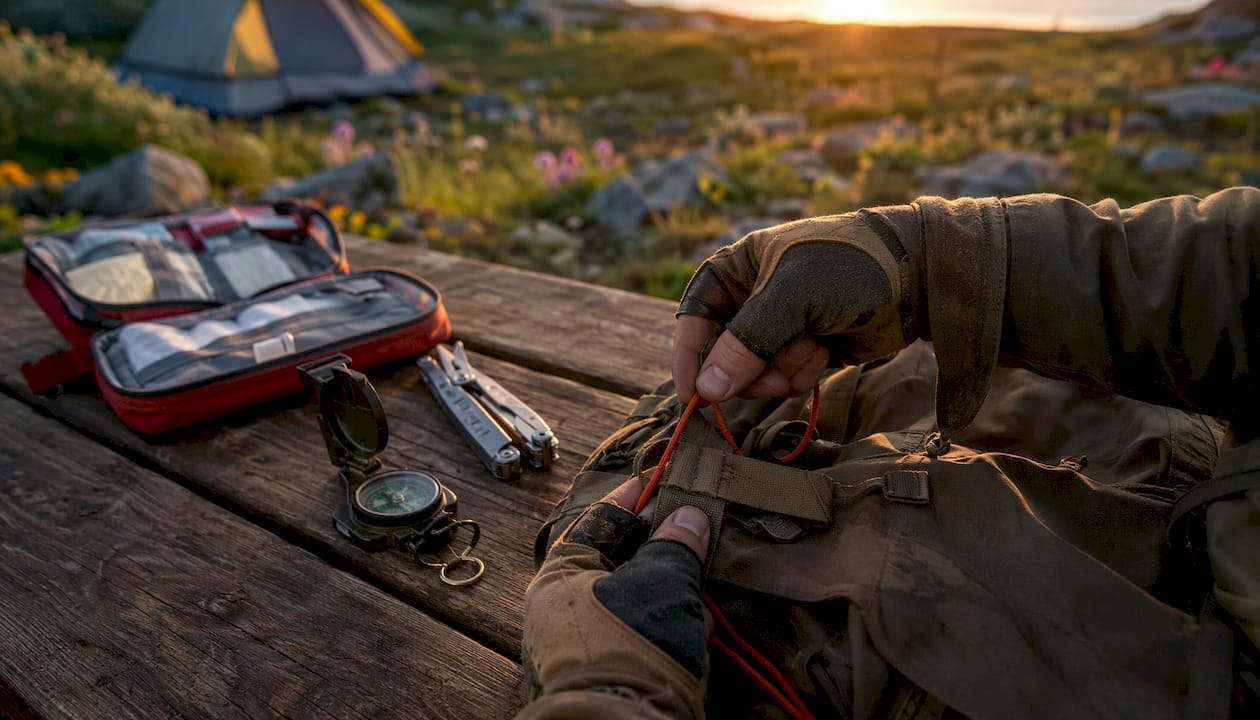
Weight and packability: A 100-foot hank of 550 paracord fits in a jacket pocket. There is no reason to carry less than 50 feet in any wilderness kit.
Care and storage:
Coil paracord in loose loops rather than tight wraps to prevent kinking.
Store it away from direct sunlight, which degrades nylon over time.
Rinse mud and salt off after use and let it dry completely before storing.
Inspect the sheath for cuts or abrasion before each trip. A damaged sheath does not always mean the inner strands are compromised, but it is worth checking.
For natural cordage, offset splices by at least 3 inches and maintain 2–3 twists per strand before each crossing. Inconsistent twist count is the most common cause of weak spots and premature failure.
When to use natural cordage instead of paracord:
Natural cordage makes sense when you want to conserve your manufactured supply for high-load applications, or when you are practicing field skills and want to reduce dependence on gear. Dogbane and stinging nettle produce the strongest natural cord available in most of North America. Cattail is widely available but significantly weaker, best limited to bundle lashing and low-load bindings. For any application where failure creates a safety risk, use paracord or braid multiple natural strands to compensate for lower individual strength.
Knots worth knowing before you go:
Bowline: Fixed loop that does not tighten under load, easy to untie
Clove hitch: Fast anchor to a pole or branch, adjustable
Taut-line hitch: Adjustable tension on a ridgeline or guy line
Square lashing: Joins two poles at right angles for shelter frames
Sheet bend: Joins two cords of different diameters
Reef knot: Flat, secure knot for bandages and gear ties
Knowing these six knots covers the majority of real survival scenarios. Cordage without knot knowledge is just rope sitting in your pack. The combination of good cord and practiced knots is what actually builds shelters, sets traps, and gets people home.
For a broader look at what belongs in your outdoor emergency loadout, the tactical gear selection guide at FS9 Tactical covers cordage alongside other core categories worth thinking through before your next trip.
Key Takeaways
Paracord’s 550-lb rated strength, combined with its inner strands for fine-work applications, makes it the single most versatile item in any survival kit.
Point | Details |
Paracord strength advantage | Intact 550 paracord holds 550 lbs; even the best natural cordage tops out at 60–80 lbs at the same diameter. |
Inner strands multiply uses | Stripping the sheath yields fine strands for fishing line, snares, sewing thread, and dental floss. |
Natural cordage as backup | Dogbane and nettle produce the strongest field-made cord; cattail works only for low-load lashing. |
Knots determine outcomes | Six knots (bowline, clove hitch, taut-line hitch, square lashing, sheet bend, reef knot) cover most survival scenarios. |
Cordage shaped human evolution | A 3-ply cord fragment from Abri du Maras shows Neanderthals were making cordage at least 41,000–52,000 years ago, requiring the same cognitive complexity as language. |
Recommended
Comments