

Pick the Right Sleeping Pad R Value: 5 Steps for Any Temp

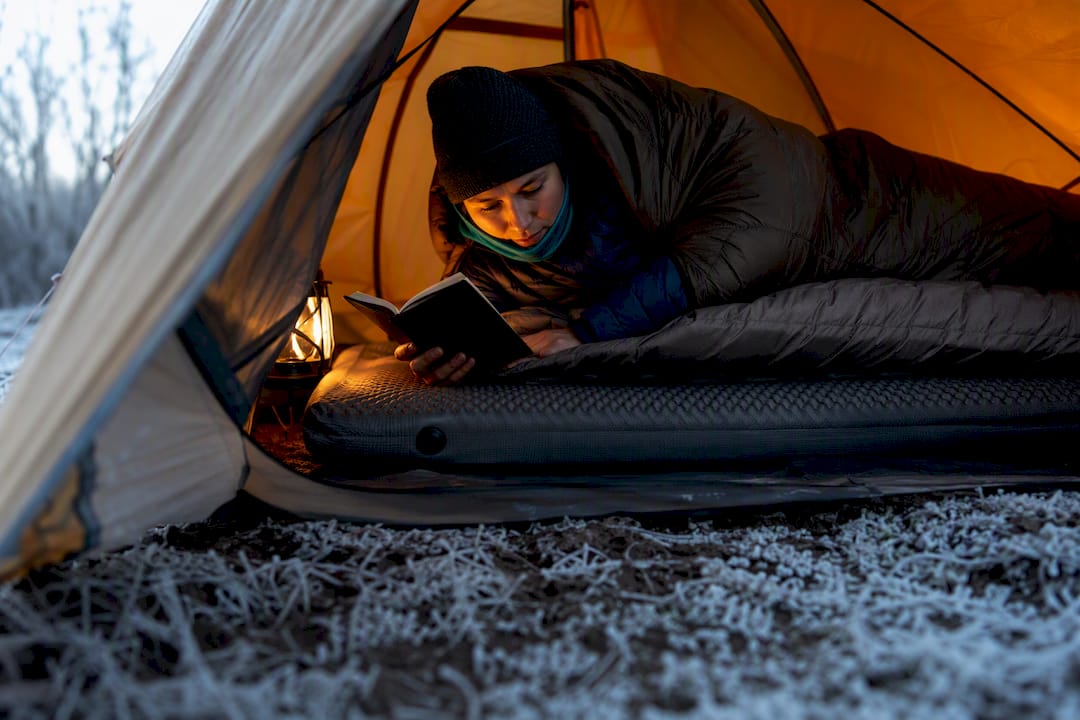
R-value measures a sleeping pad’s resistance to heat loss into the ground, and it’s the single most reliable number for predicting whether you’ll sleep warm or shiver until dawn. For summer trips, aim for R≈2. For three-season camping, look for R≈3 to 4. For cold or winter nights, go R≥5, and remember that stacking two pads adds their R-values together. The ASTM FF3340 standard now makes these numbers comparable across brands, so a rating from one company means the same thing as a rating from another.
TL;DR:
Most sleeping pads in the R 3 to 4 range are suitable for three-season camping, with higher values needed for winter conditions.
ASTM FF3340 testing standard allows direct comparison of R-values across brands, but field performance can vary due to ground conditions and pad wear.
Layering pads (such as stacking foam and inflatable pads) increases overall R-value, often saving costs compared to buying a single high-R-value pad.
For cold or winter trips, adding a foam pad underneath an inflatable pad can achieve R 6 or higher, providing redundancy and comfort.
Site selection and pre-trip testing of your sleep system are essential to accurately assess insulation needs and prevent cold spots during overnight stays.
Table of Contents
What Sleeping Pad R-Value Actually Measures
R-value describes thermal resistance, the rate at which heat passes through a material. A higher number means heat escapes more slowly from your body into the cold ground beneath you. This matters more than most campers realize, because ground conduction steals heat far faster than the surrounding air ever will. Lie directly on frozen dirt without insulation and you’ll lose warmth in minutes, even if the air temperature is mild. Your sleeping bag traps air around your body, but it does almost nothing to stop the cold creeping up from below. That job belongs entirely to the pad.
The scale isn’t as simple as “double the number, double the comfort.” An R-4 pad does provide roughly twice the thermal resistance of an R-2 pad, in strict physics terms. But your body doesn’t perceive warmth on a straight line. The jump from R-2 to R-4 can feel dramatic on a cold night, while the difference between R-6 and R-7 might barely register unless you’re already right at the edge of freezing. Diminishing returns kick in at the high end, which is worth knowing before you overspend on an expedition-grade pad for a car-camping trip in June.
A few points worth keeping straight when you’re comparing pads:
R-value is additive but not simply “twice the comfort” for double the number. Physiological response to warmth isn’t linear.
Ground temperature usually runs colder than air temperature overnight, especially on bare rock, packed dirt, or snow.
Wind and convection matter for your shelter, but R-value only addresses conductive heat loss through the pad itself.
A thin foam pad with a low R-value can still outperform an uninsulated air mattress, because trapped air resists conduction even without added insulation layers.
Sleeping pad insulation isn’t about keeping you warm the way a blanket does. It’s about slowing a very specific kind of heat theft, one that happens the moment your body weight presses fabric against cold ground.
How R-Value Is Measured: The ASTM Test and Its Limits
Before 2020, R-value claims were close to meaningless. Every manufacturer tested pads differently, some barely tested at all, and a “3-season” label from one brand might perform nothing like a “3-season” label from another. The ASTM FF3340 standard changed that by defining a standardized two-plate test: a heated plate on the bottom, a cooled plate on top, with the pad sandwiched between them under controlled pressure that simulates a sleeper’s weight. The apparatus takes multiple measurements and averages them, which is why post-2020 R-value numbers from different brands can finally be compared directly.
Fast Fact: Major retailers including REI and MEC now require or prominently display ASTM-tested R-values on sleeping pad listings, a shift that started industry-wide adoption around 2020.
Even with standardization, real-world conditions introduce variables the lab can’t fully capture:
Under-inflation reduces effective R-value because compressed air pockets conduct heat faster than fully expanded ones.
Wet or frozen ground pulls heat away faster than the dry lab-test surface, so field performance can run colder than the rated number suggests.
Foam pads lose some loft and insulating capacity as they age and compress over years of use.
Reflective internal layers (common in air pads) can behave differently depending on ambient humidity, something the two-plate test doesn’t fully replicate.
Treat the ASTM number as a strong baseline, not a guarantee. Backpacking Light’s testing coverage makes a similar point: R-values are useful for comparison, but field variables mean you should build in a margin rather than cutting it razor thin.
Choosing Your R-Value by Season and Temperature
Matching R-value to expected conditions is the whole game, and the industry has settled into fairly consistent bands. REI’s guidance breaks it down by season, and most gear makers now follow similar ranges:
Summer camping (warm nights, above 40°F): R-value under 2 is usually enough.
Three-season camping (spring through fall, occasional near-freezing nights): R 2 to 3.9 covers most trips comfortably.
Cold-weather camping (regular sub-freezing lows): R 4 to 5.4 is the sweet spot.
Winter and expedition camping (deep freeze, snow on the ground): R 5.5 and above, sometimes climbing past 7 for serious cold.
Statistic Callout: Popular backpacking pads generally fall in the R 1 to 7 range, with most three-season pads clustering between R 3 and R 5, and true winter and expedition pads pushing past R 7.
Here’s a quick-reference way to think about it if you know your trip’s expected overnight low:
Expected overnight low | Suggested minimum R-value |
above 40°F | R 1 to 2 |
spring through fall | R 2 to 3 |
near-freezing nights | R 3 to 4 |
sub-freezing lows | R 4 to 6 |
Below 0°F | R 6+ |
Those numbers are starting points, not finish lines. A few situations call for padding your margin:
Side sleepers compress the pad more at the hips and shoulders, which thins the insulating layer right where you need it most. Adding 0.5 to 1.0 to your target R-value is a common fix.
Naturally cold sleepers should round up a full band rather than sitting at the minimum for their expected temperature.
Wet or frozen ground (think early spring mud or a hard freeze after rain) pulls more heat than dry dirt, so add a buffer even if the air temperature looks manageable.
Snow camping demands the top of the winter band regardless of air temperature, since you’re insulating against a surface that’s permanently at or below freezing.
How R-Value Works With Your Sleeping Bag and Layers
Your sleeping bag and pad aren’t independent purchases. They’re one system, and the industry’s own testing protocols assume that. EN/ISO sleeping bag temperature ratings, the standardized labels you see on most bags, are tested assuming a pad with roughly R 4.8. Pair that same bag with a pad rated R 2, and you’ll sleep colder than the tag promises, no matter how good the bag’s fill is. This catches a lot of people off guard, since the bag gets all the marketing attention while the pad quietly determines whether that rating holds up.
R-values stack when you layer pads with no air gap between them. Put a closed-cell foam pad rated R 2 underneath an inflatable pad rated R 3, and you get roughly R 5 combined, give or take a small reduction some field reports put around 5 to 10 percent for real-world imperfect contact. This is the classic winter strategy: rather than buying one expensive R 6 air pad, many campers combine a cheap foam pad with a mid-range inflatable and land in the same neighborhood for less money and more redundancy.
Clothing and shelter matter too, though they work on air temperature rather than ground conduction. A liner or extra base layer buys you a few degrees of margin on borderline nights, and a solid shelter cuts wind chill that would otherwise sap warmth through convection. Neither substitutes for pad insulation, but together they round out a complete system. If you’re dialing in a broader cold-weather setup, layering strategy for outdoor comfort covers the clothing side of that equation in more depth.
Stacking pads is additive: foam R-2 plus air pad R-3 gets you close to R-5.
EN/ISO bag ratings assume roughly R-4.8 underneath, so a low-R pad undercuts your bag’s advertised rating.
Clothing and shelter address air temperature and wind, not ground conduction, so they complement pad R-value rather than replacing it.
Pro Tip: If you already own a mid-range pad and a big cold-weather trip is coming up, buy a cheap R-2 foam pad before buying a whole new sleep system. Stacked underneath your current pad, it often gets you into winter-ready territory for a fraction of the cost.
A Step-by-Step Framework for Picking Your R-Value
Most people overthink this or, worse, guess. Here’s a workflow that removes the guesswork without turning gear shopping into a physics project.
Check the forecast, then check the ground. Look up the expected overnight low for your specific trip dates and location, not a seasonal average. Then think about ground state: dry dirt, wet soil, snowpack, or bare rock all behave differently, and wet or frozen ground pulls more heat than the air temperature alone suggests.
Set your baseline from the seasonal bands. Use the temperature-to-R chart above to land on a starting R-value. If your low is 25°F, you’re in the R 3 to 4 range before any adjustments.
Add margin for your sleep profile. Side sleepers add 0.5 to 1.0. Cold sleepers round up to the next full band. If you’re camping on wet or frozen ground rather than dry, add another buffer rather than sitting at the bare minimum.
Weigh the trade-offs. Higher R-value generally means more weight, more bulk, and a higher price tag. Switchback Travel’s testing notes point to R 4 to 4.5 as a versatile sweet spot for campers who don’t want to own three different pads for three different seasons. If you camp across a wide range of conditions, consider a mid-range pad plus a cheap foam pad you can stack for the occasional cold trip, rather than buying one expensive high-R pad you’ll only use twice a year.
Run the purchase checklist before you buy. Does the listing show an ASTM-tested R-value, or just a vague “3-season” label? What’s the packed weight and size? Does it have any puncture protection or a reinforced bottom layer, especially if you plan to use it without a footprint?
That last step matters more than it sounds. A pad without a clearly stated ASTM R-value is a pad you’re buying on faith, and faith doesn’t keep you warm at 2 AM.
Pro Tip: Write down your trip’s expected low the night before you pack, not the week before. Mountain forecasts shift fast, and a pad rated for 30°F comfort gets uncomfortable fast if the actual low drops to 18°F.
Foam, Air, and Self-Inflating Pads: Matching Construction to R-Value
The three main pad constructions hit very different points on the R-value spectrum, and each comes with its own trade-offs beyond warmth alone.
Closed-cell foam pads typically deliver somewhere around R 2 per pad, depending on thickness and density. They’re cheap, nearly indestructible, and impossible to puncture, which makes them a favorite as an underlayer rather than a standalone solution for cold trips. Their downside is comfort: they’re thin and firm, which is fine for a lot of sleepers but rough on side sleepers or anyone used to a plush setup.
Insulated air pads cover the widest range, from around R 3 up past R 7 for expedition models, achieved through internal baffles, reflective films, or synthetic and down fill inside the air chambers. These pads offer the best warmth-to-weight ratio on the market, which is why they dominate backpacking gear lists. The trade-off is durability: a puncture on a solo air pad with no backup means a genuinely miserable night.
Self-inflating and hybrid pads sit in the middle, using open-cell foam that partially expands on its own combined with a valve for topping off air. They typically land in the R 3 to 5 range and offer a durability compromise between pure foam and pure air, at the cost of extra packed weight compared to air-only designs.
Closed-cell foam: roughly R 2, cheapest, most durable, best as a stacking underlayer.
Insulated air pads: roughly R 3 to 7+, best warmth-to-weight ratio, most vulnerable to punctures.
Self-inflating hybrids: roughly R 3 to 5, a durability and comfort middle ground.
If you’re building a shelter setup around one of these pads, ground contact and wind exposure both factor in. A tarp setup that keeps wind off your sleeping area reduces how hard your insulation has to work in the first place.
Reading the Label: What to Trust and What to Question
The single most useful habit here is simple: look for the ASTM FF3340 number specifically, not a vague “cold weather” or “3-season” sticker. Pads tested to the ASTM standard will usually say so explicitly, often right next to the number itself. Pre-2020 pads and some budget brands still rely on inconsistent internal testing methods, so a “winter-rated” claim without a specific R-value attached deserves skepticism.
A short checklist for evaluating any pad you’re considering:
Does the product page list a specific numeric R-value, or just a season name with no number?
Is that number attributed to ASTM FF3340 testing, or an unnamed internal method?
If two pads claim the same season rating but different numeric R-values, trust the number over the label every time.
If you already own a pad with no R-value listed anywhere, and the manufacturer’s site doesn’t help, you’ve got two practical options. First, check the pad’s fill and construction against known ranges from similar pads of that era and thickness. Second, and more reliably, just stack it with a known-R closed-cell foam pad on a genuinely cold test night and see how it performs. Field testing beats guessing every time a label goes silent.
Field Notes: Site Selection and Quick Checks That Actually Work
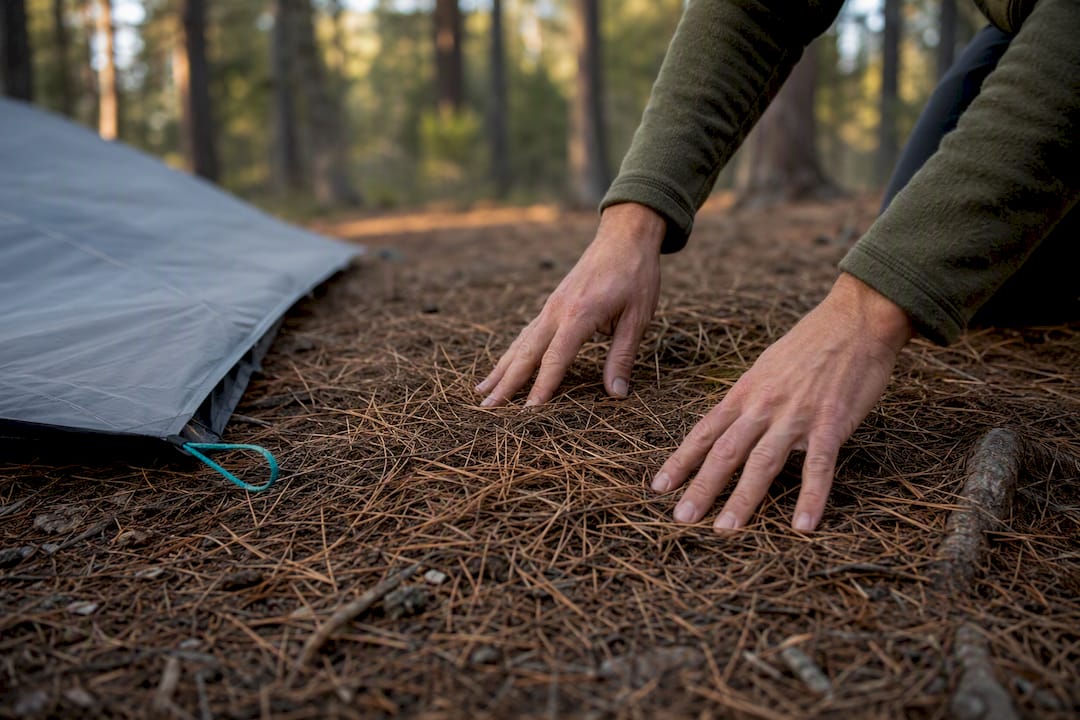
Site selection changes your effective warmth before you even inflate anything. Avoid pitching on saturated ground or low spots where cold air and moisture pool overnight, and if frost is a possibility, a bed of dry leaves or pine needles under your tent footprint adds a surprising amount of buffer against ground chill.
A thin closed-cell foam pad under your air pad does double duty: it adds insulation on the cheap and protects your inflatable from sharp rocks or roots that would otherwise end your night early with a slow leak. It’s the single best five-dollar insurance policy in a pack.
Before any cold-weather trip, run a real test at home. Inflate the pad fully, lie on it in the actual clothing layers you’ll wear camping, and pay attention to any cold spots at your hips or shoulders. If you feel the ground through the pad anywhere, that’s your system’s weak point, and it’s better to find it on your living room floor than at elevation.
Pro Tip: Test your full sleep system, pad included, on your coldest local night before a big trip. A garage floor or a chilly patio at 3 AM tells you more than any product description ever will.
Three Trips, Three Pads: How the Framework Plays Out
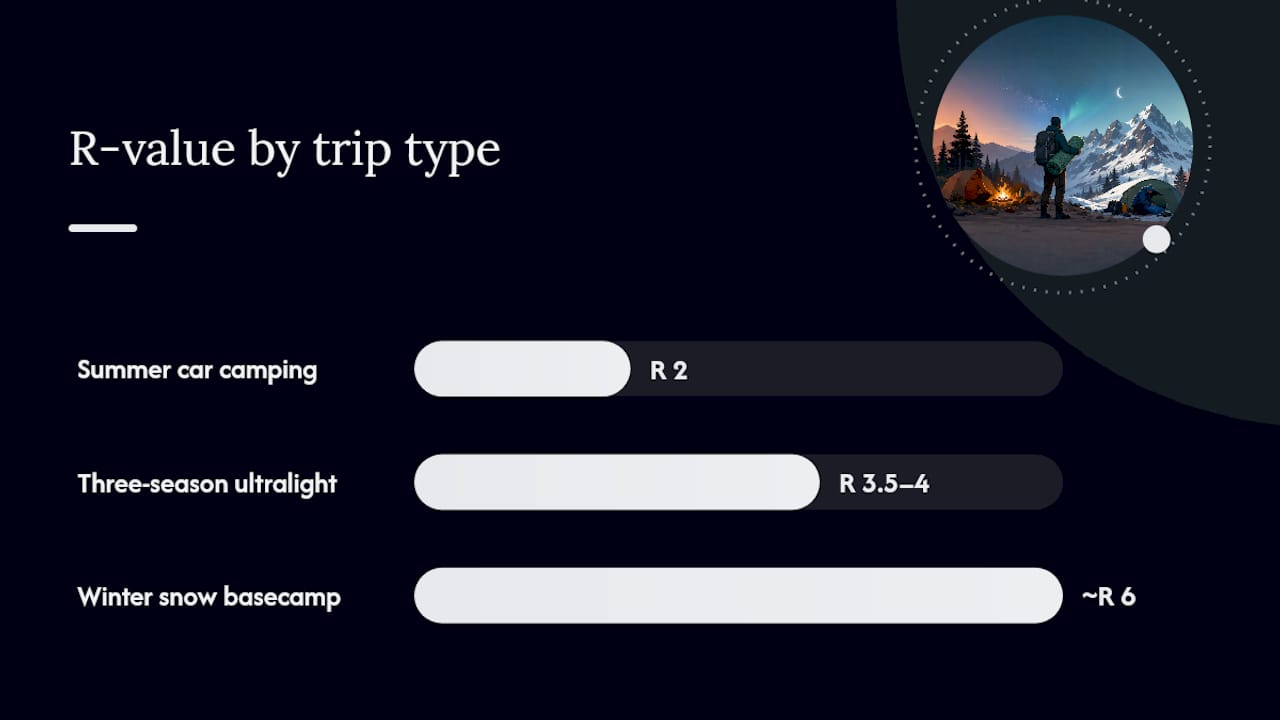
For a summer car-camping weekend with lows around 55°F, an R 2 pad is genuinely enough, and I’d rather carry that lighter, cheaper option than lug an R 5 pad I don’t need. For a long ultralight trip through variable three-season terrain, I lean toward R 3.5 to 4, accepting a slightly heavier pack in exchange for not gambling on an unexpected cold front. For winter basecamp trips on snow, I stack a foam R 2 under an air pad rated R 4, landing near R 6 combined, because redundancy matters more than shaving ounces when a puncture at 10°F isn’t an option. I build in that margin every time rather than cutting it close, since a slightly heavier pack beats a genuinely cold, sleepless night.
Keep Building Your Cold-Weather Know-How
Getting the R-value right is one piece of a bigger system, and the same principles that govern pad insulation show up again in shelter choice, layering strategy, and site selection for any season. Resources cover topics from minimalist shelter options to multi-use gear on longer trips.
If you’re planning a specific trip this season, whether that’s a snowy basecamp weekend or a long shoulder-season traverse, the Thrillofit resource hub has field guides on shelter setup, site selection, and gear pairing that go well beyond what fits in one article. Browse the latest guides and start matching your full sleep system, not just your pad, to the conditions you’ll actually face.
Sources
Recommended
Comments