

U.S. Hikers: Identify Venomous Snakes Safely with 3 Field Photos

There’s no single trait that identifies every venomous snake in the United States, so relying on one visual shortcut is how people get hurt or misidentify a harmless snake as a threat. The reliable method is regional: learn the venomous species that actually live in your area, then use whole-body cues, from a safe distance, to narrow things down. If you’re ever within striking range of a snake you can’t identify, back away, photograph it from afar, and if a bite happens, get medical care immediately rather than trying to diagnose it yourself.
TL;DR:
Most U.S. venomous snakes belong to pit vipers or coral snakes, but rapid identification methods like head shape or pupils are unreliable at a distance.
Key field signs include rattles for rattlesnakes, hourglass patterns for copperheads, white mouths for cottonmouths, and banding patterns for coral snakes, which require close inspection.
Relying on regional range maps and habitat clues is safer and more accurate than memorizing rules or using single traits for identification.
In case of a bite, immobilize the victim, avoid home remedies, and seek emergency medical care, as symptoms evolve over time and need professional assessment.
Use binoculars, photographs, and habitat context from a safe distance to identify snakes, and treat all suspected venomous bites seriously regardless of appearance.
Table of Contents
Key Physical Traits for Venomous Snakes Identification
Almost every venomous snake native to the U.S. falls into one of two groups: pit vipers and coral snakes. They don’t share a lookalike playbook, which is exactly why single-trait rules fail so often.
Pit vipers, which cover rattlesnakes, copperheads, and cottonmouths, get their name from the heat-sensing pits between their eyes and nostrils. Add the vertical, cat-like pupils and a thick, triangular head sitting on a noticeably narrower neck, and you have the classic profile. The catch: you need to be dangerously close to see a pit or a pupil shape, and juvenile pit vipers can look leaner and less “triangular” than adults. Never use head shape or pupil shape as your only check.
Coral snakes play by different rules entirely. They’re slender, brightly banded in red, yellow, and black, and belong to a different family (Elapidae) with fixed front fangs rather than the hinged fangs of pit vipers.
A few working traits worth knowing at a glance:
Pit vipers: heavy body, blocky head, rattlesnakes typically have a rattle (though it can break off).
Coral snakes: red and yellow bands touch each other; harmless mimics usually have red touching black.
Both groups: pattern and color vary regionally, sometimes within the same species.
Neither trait set is visible or reliable at a distance greater than a few feet.
Field note: Most bites in the U.S. involve pit vipers, since they’re both more widespread and more frequently encountered near trails, woodpiles, and yards, while coral snakes are regionally restricted and rarely encountered outside the southeastern states and parts of the Southwest.
Short Species Profiles: Rattlesnakes, Copperheads, Cottonmouths, and Coral Snakes
Each of these four groups has its own field signature, and knowing the differences beats memorizing one universal rule.
Rattlesnakes are the easiest to identify when they cooperate. A visible rattle and that characteristic buzzing sound are strong indicators, but young rattlesnakes have underdeveloped rattles, and older ones sometimes lose segments. Look instead for a heavy, diamond or blotched pattern along the back and a blocky head. They favor rocky outcrops, dry brush, and desert scrub, though regional species vary by habitat.
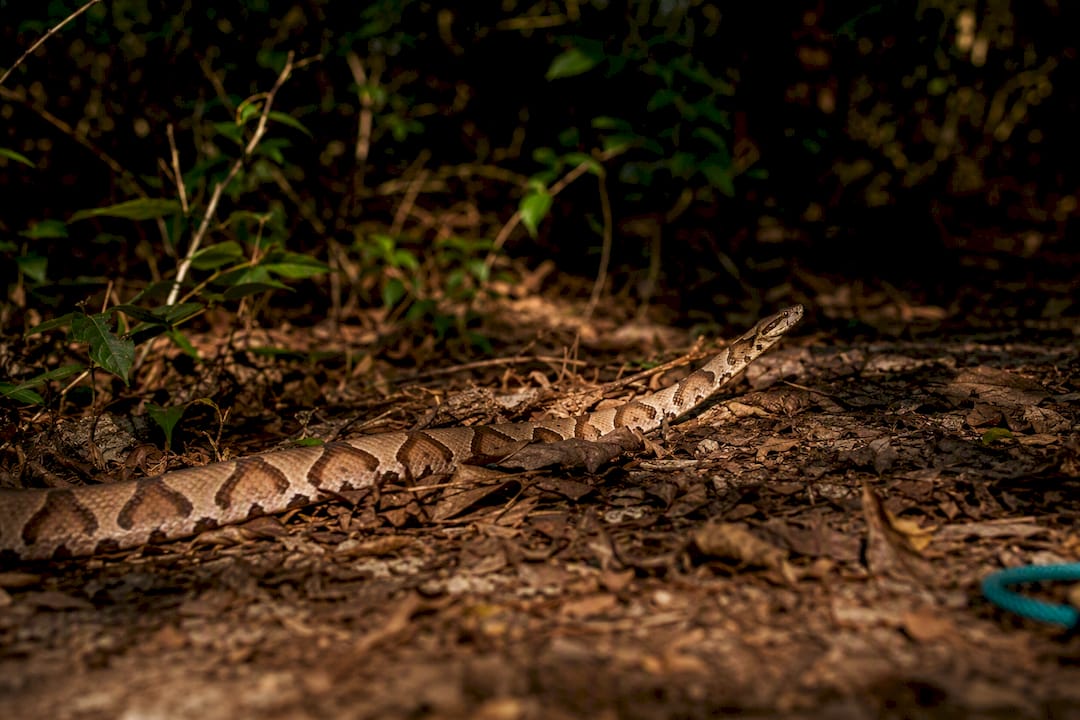
Copperheads show a distinct hourglass or “Hershey’s Kiss” pattern in tan and brown down the length of the body. Juveniles have a bright yellow or greenish tail tip they wiggle to lure prey, a behavior sometimes mistaken for aggression. They turn up in leaf litter, wood piles, and suburban edges more than deep wilderness.
Cottonmouths, also called water moccasins, are semi-aquatic and often float with their head held above the surface. When threatened, they gape to reveal a bright white mouth lining, which is where the name comes from. Nonvenomous water snakes swim with their whole body submerged and lack that white-mouth display, which is a more useful field cue than head shape.
Coral snakes are small, rarely thicker than a pencil, with red, yellow, and black rings encircling the entire body. Band order and width vary by region, and several nonvenomous mimics (like the scarlet snake) share similar coloring, which is why range and pattern matter more than a rhyme you half remember.
Common Misidentifications and Myths to Avoid
Several widely repeated “rules” for spotting venomous snakes are unreliable enough that wildlife agencies actively warn against them. Head shape and pupil shape top that list. Several harmless species, including hog-nosed snakes, can flatten and widen their heads defensively, mimicking a pit viper’s silhouette. State guidance is blunt about this: don’t use a single trait to make a safety decision.
Tail-vibrating and coiling behavior is another trap. Bullsnakes and hog-nosed snakes both rattle dry brush with their tails and coil defensively, imitating a rattlesnake’s warning display without carrying any venom.
Head shape and pupil shape: unreliable, easily mimicked, and impossible to check safely up close.
Rattling or buzzing sounds: several nonvenomous species fake this.
A dead snake: still dangerous. Reflex strikes can happen for a while after death, and venom glands can still function.
Pro Tip: If you find a dead snake on a trail or in your yard, leave it alone and photograph it from where you stand. Reflexive bites from freshly killed snakes are a documented risk you don’t need to take.
How to Safely Assess a Snake From a Distance
You don’t need to get close to identify a snake correctly, and getting close is exactly how most bites happen. Build a habit around this short sequence instead:
Stop moving and put several meters between you and the snake immediately.
Use binoculars or your phone’s zoom to get a clearer look without closing the gap.
Photograph the whole body first, then attempt a closer zoomed shot of the head and pattern.
Note the habitat: dry rock, leaf litter, near water, or open grass.
Compare what you saw against your state’s range map or extension guide once you’re safe.
A few habits make this workflow faster and safer:
Keep a mental (or bookmarked) list of the venomous species documented in your county before you head out.
Never nudge, poke, or move a snake with a stick to get a “better look.”
If you can’t identify it confidently, treat it as venomous and give it a wide path.
Narrowing candidates by county first, then matching photos to your state’s example images, cuts down guesswork fast and keeps you at a safe working distance the whole time.
What to Do If a Snake Bites You
Skip the movie-logic first aid. Do not cut the wound, apply a tourniquet, or attempt to suck out venom, all of which cause more tissue damage without slowing venom spread. Keep the bite victim as still and calm as possible, since movement speeds circulation and venom distribution, and call emergency services or get to a hospital right away.
Clinicians don’t rely on guesswork either. They track symptom progression, run lab work, and observe the patient over time before deciding whether antivenom is warranted, since the decision hinges on how symptoms evolve, not a single test result.
Swelling, pain, and bruising near the bite often begin within minutes to an hour for pit viper bites, though onset varies by species and bite location.
Systemic signs, like nausea, tingling, or changes in taste, signal broader involvement and need faster escalation.
Dry bites, where no venom is injected, happen often enough that a bite without immediate symptoms still needs evaluation.
For a fuller field breakdown of what to expect and how to react, Thrillofit’s snake bite survival guide walks through the sequence step by step, and the copperhead bite symptoms guide covers one of the most commonly encountered cases in detail.
Why Trust This Guide
This guide comes from Thrillofit, where author S covers outdoor safety topics including snake-bite response and field identification practices for hikers, campers, and backyard encounters alike. The sourcing here leans on state wildlife agency publications, university extension guides, and peer-reviewed clinical references on envenomation rather than folklore or forum advice.
Author credentials, field certifications, and additional bio details for S are being expanded and will be added to future updates of this guide.
Distinguishing Venomous vs. Non-Venomous Snake Behavior
Behavior offers real clues, but only as a supplement to knowing your local species, never as a replacement. Venomous snakes generally prefer avoidance to confrontation. Most will freeze, retreat, or attempt to slip away before ever coiling to strike, and most bites happen because a person approached, cornered, or handled the snake, not because the snake went hunting for a fight.
Rattlesnakes will often rattle as a warning before striking, though a snake that has already been startled or grabbed may skip the warning entirely. Cottonmouths tend to stand their ground more than other pit vipers, gaping to display that white mouth lining rather than fleeing immediately, which sometimes gets misread as aggression when it’s actually a bluff display.
Coiling itself isn’t diagnostic. Both venomous and nonvenomous species coil defensively, and several harmless snakes, hog-nosed snakes especially, put on an elaborate show of flattening their heads, hissing, and even playing dead when threatened. That performance fools plenty of experienced hikers.
The safest behavioral read is distance and context together: a snake that’s actively retreating from you and disappearing into cover is telling you what it wants, regardless of species. One that holds its ground, rattles, or gapes deserves a wider berth and a slow retreat on your part, not a closer look.
Overview of Venom Types and Their Effects
Pit viper venom is primarily hemotoxic, meaning it targets blood and tissue rather than the nervous system directly. It breaks down blood vessels, interferes with clotting, and causes localized swelling, bruising, and tissue damage around the bite site. Rattlesnake, copperhead, and cottonmouth venoms all fall into this category, though potency and volume delivered vary widely by species, size, and the individual bite itself.
Coral snake venom works differently. It’s primarily neurotoxic, affecting nerve signal transmission rather than blood and tissue. Symptoms can include muscle weakness, drooping eyelids, and difficulty breathing in severe cases, and they sometimes develop more slowly than the immediate pain and swelling typical of a pit viper bite. That delay is part of why coral snake bites are especially dangerous: a victim can feel deceptively fine for hours before serious symptoms set in.
Neither venom type is something you can assess from a bite alone. Clinicians rely on symptom progression and lab monitoring over time rather than a snapshot judgment, which is exactly why every suspected venomous bite, hemotoxic or neurotoxic, needs professional evaluation rather than a wait-and-see approach at home.
Seasonal and Habitat Factors That Affect Snake Visibility
Snake activity tracks temperature closely, which means your odds of an encounter shift dramatically across the year. Spring and fall tend to bring the highest visibility, since snakes are active during daylight hours when temperatures sit in a comfortable middle range. Peak summer heat pushes many species toward dawn, dusk, and nighttime activity instead, when pavement and rock surfaces cool down enough to be tolerable.
Winter changes the picture entirely in most of the country. Cold-blooded physiology means snakes go dormant, denning up in rock crevices, burrows, or under debris, so encounters drop sharply outside the warmer Gulf Coast and desert Southwest regions where mild winters keep some activity going year-round.
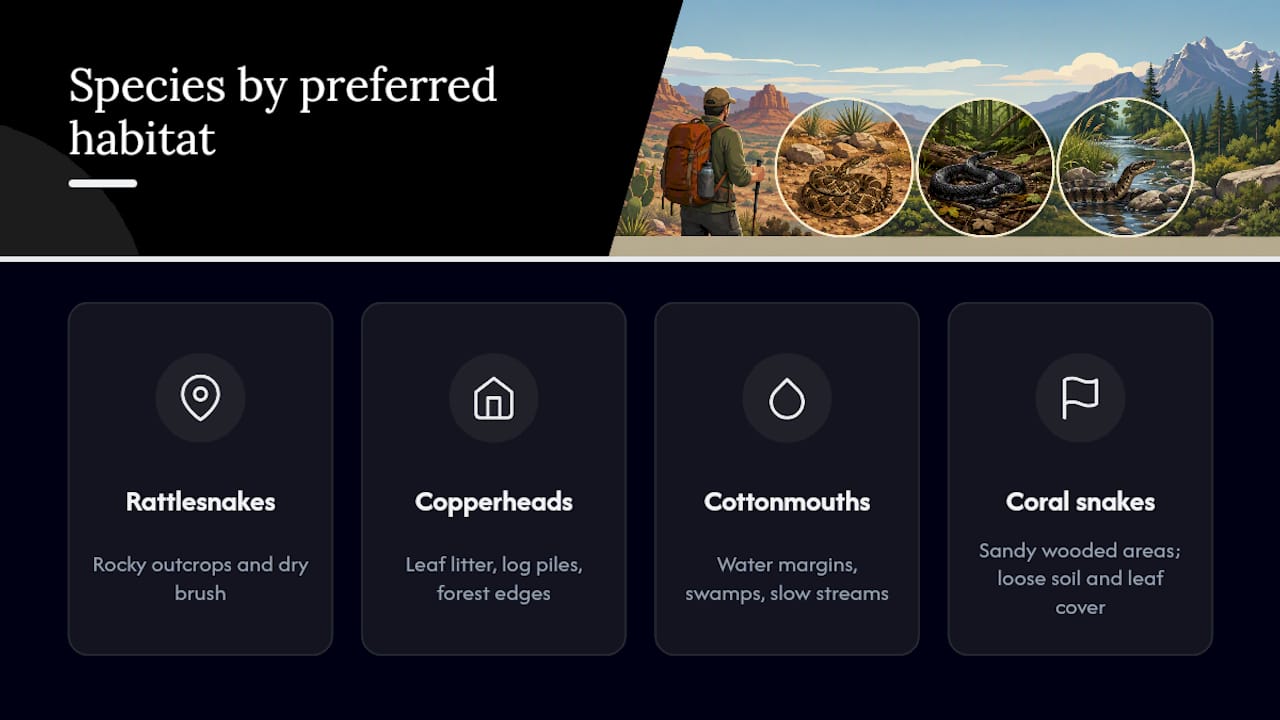
Habitat matters just as much as season. Rocky outcrops and dry brush favor rattlesnakes. Leaf litter, log piles, and forest edges favor copperheads. Water margins, swamps, and slow-moving streams are cottonmouth territory. Coral snakes prefer sandy, wooded areas with loose soil or leaf cover where they can burrow.
Time of day compounds all of this. A midday summer hike through open rock is a different risk profile than a dusk walk along a creek bank in October, even in the exact same county. Building basic seasonal awareness into your outdoor planning, alongside knowing your local species, cuts down on surprise encounters more than any single identification trick ever will.
Photographic Identification Tips
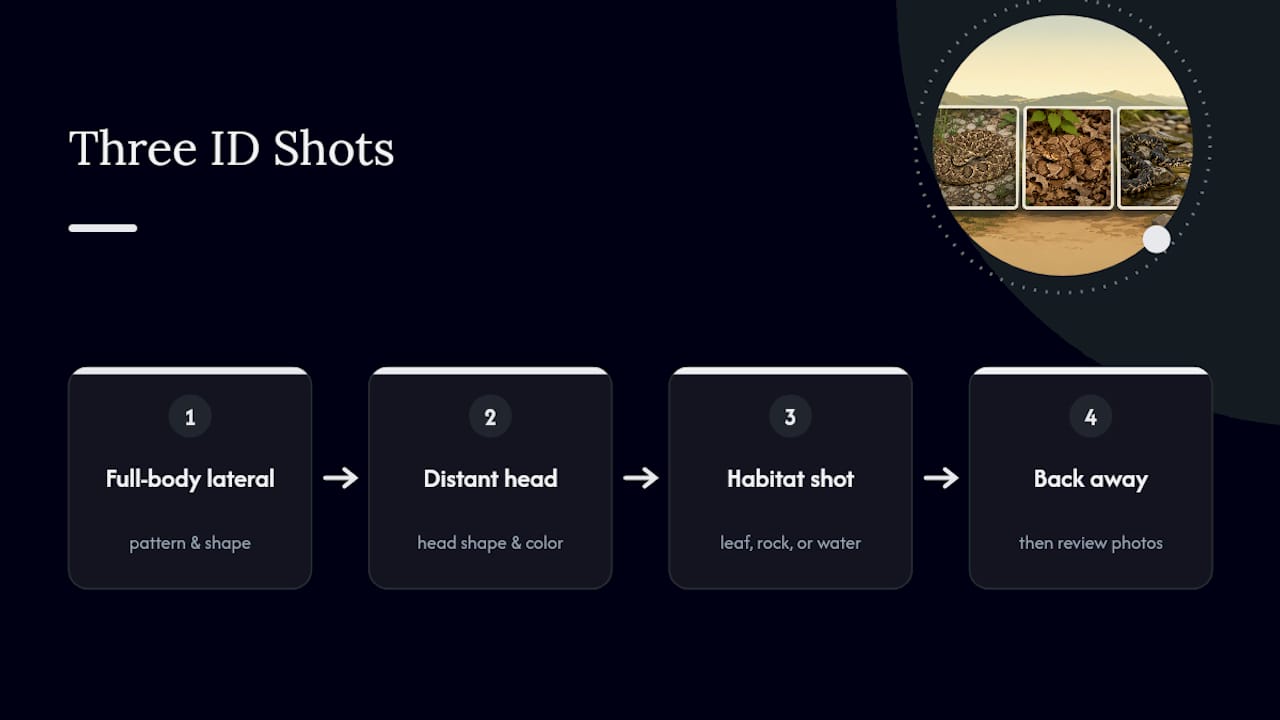
A good identification photo does more work than a good look with the naked eye, and it keeps you at a safe distance the entire time. Three shots consistently give the most useful information: a full-body lateral shot showing the entire snake’s pattern and shape, a zoomed head-on shot capturing head shape and coloring without closing the gap, and a habitat shot showing the surrounding terrain, whether that’s leaf litter, rock, or water’s edge.
Lighting matters more than people expect. Overcast days or shaded photos often wash out pattern contrast that would otherwise help distinguish, say, a copperhead’s hourglass bands from a similarly colored nonvenomous species. If you can angle for indirect light without moving closer, take the extra second.
Zoom optically when your camera allows it rather than cropping later, since digital zoom loses detail exactly where you need it most, on scale patterns and banding. A tripod or steady rest, even a fence post or your own knee, beats a shaky handheld shot every time.
Resist the urge to circle around for a “better angle.” One clear set of three photos from a stable position beats a dozen blurry ones taken while maneuvering closer. Once you have your shots, back away first, then review the images.
Using Technology and Apps for Snake Identification
Photo-identification apps have gotten genuinely useful for narrowing down species, though none of them replace regional knowledge or a field guide. Most general wildlife identification apps built on crowd-sourced photo databases can flag broad categories, like family or genus, reasonably well but stumble on the fine details that separate a venomous species from its nonvenomous lookalike.
The stronger approach pairs an app’s quick suggestion with your state wildlife agency’s range map or extension publication as a confirmation step. If the app suggests copperhead and your county’s range map confirms copperheads are documented nearby, you’ve got a reasonably solid match. If the app guesses wildly, or the suggested species isn’t listed for your region at all, treat the result skeptically.
Some state agencies and universities publish their own identification tools or photo-comparison pages specifically calibrated to species found within their borders, and those tend to outperform generic apps for regional accuracy. Bookmarking your state’s extension herpetology page before a trip takes a few minutes and pays off far more than any single app download.
Treat all of these tools as a narrowing step, not a final verdict. The goal is reducing your list of possibilities to something you can cross-check against a real photo and a real range map, not getting a definitive answer from an algorithm.
A Field Lesson in Trusting the Range Map Over Instinct
On a scouting trip through rocky brush country, S once spotted a thick, patterned snake coiled near a trailhead and immediately assumed rattlesnake based on the heavy body and blotched pattern. A quick check of the state’s online range map for that county told a different story: the timing and habitat lined up better with a common nonvenomous species documented in the area, and the “rattle” sound turned out to be a hog-nosed snake’s tail rustling dry leaves.
That five-minute pause, instead of a snap judgment, avoided an unnecessary retreat and a wasted call to a wildlife line. Regional knowledge did the work that instinct alone couldn’t.
The takeaway holds for any hiker: learn what actually lives in your county, keep your distance regardless of your guess, and let the range map settle the argument your eyes started.
— S
Get field resources before your next trip
Reading about identification is one thing. Having a checklist in your pocket when you’re standing ten feet from a coiled snake is another. This site offers outdoor safety content focused on practical, field-tested guidance that can be used mid-hike, not just studied beforehand.

Start with the snake bite survival guide for a full breakdown of emergency response steps, then check the wildlife encounter guidelines for broader protocols on staying safe around unfamiliar animals on trail. If poisonous plants are also on your radar, the poisonous plant identification guide rounds out your field hazard awareness. Browse the full Thrillofit blog for more preparedness resources, and bookmark the pages relevant to the regions where you hike most so they’re ready before your next trip, not after.
This article is general information, not a substitute for advice from a qualified doctor. Consult a qualified healthcare professional about your own circumstances before acting on anything here.
Sources
Recommended
Comments